Ram Lalla Virajman
The sanctum centres on Lord Rama in the form of a five-year-old child.
 Divine Mandir
Shri Ram Janmabhoomi Teerth Kshetra, Ramkot, Ayodhya, Uttar Pradesh 224123, India
A source-led guide to Ram Lalla Virajman at Lord Rama’s revered birthplace in Ayodhya, with practical planning for the Ramkot temple complex.
Visitor note: October to March generally offers milder weather. Ram Navami and Deepotsav are important but much busier periods.
Source: DM-RM-001-A_UP.docx. Confirm current arrangements before travelling.
Ayodhya temple guide
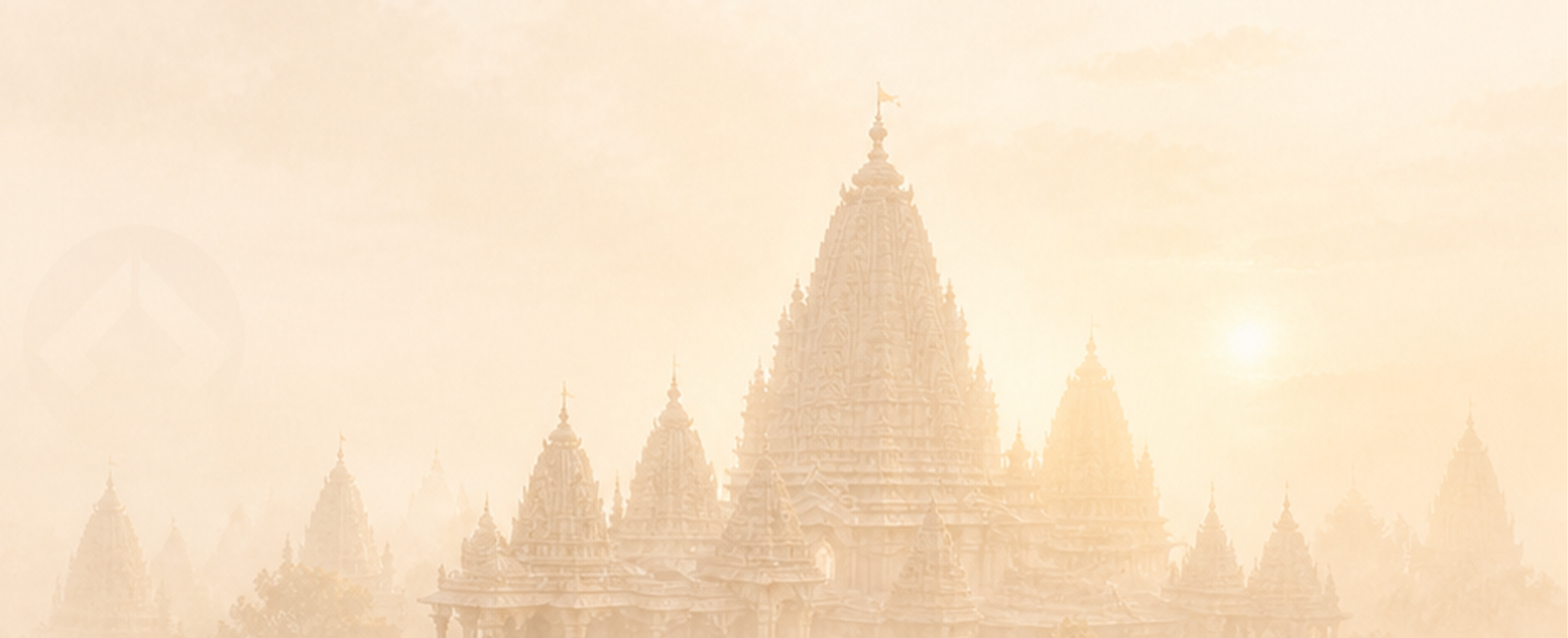
Shri Ram Janmabhoomi Mandir stands in Ramkot, Ayodhya, at the site revered in Hindu tradition as the birthplace of Lord Rama. The presiding deity is Ram Lalla Virajman, represented as a five-year-old child standing on a lotus.
The three-storey temple follows the Nagara tradition in a Maru-Gurjara expression and uses a large stone complex with multiple mandapas. The supplied source records the Pran Pratishtha of Ram Lalla on 22 January 2024.
Sanctum identity
Ram Lalla Virajman, the five-year-old child form of Lord Rama, standing on a lotus.
The sanctum centres on Lord Rama in the form of a five-year-old child.
The source describes a 51-inch dark-stone image sculpted by Arun Yogiraj, standing upon a lotus.
Ram Darbar and shrines associated with Surya, Bhagwati, Ganesha, Shiva, Annapurna and Hanuman belong to the wider complex context.
Temple identity in context
The site is revered as Lord Rama’s birthplace and is central to Ayodhya’s sacred identity.
Ram Lalla focuses devotion on the childhood form of Rama while retaining his identity as the seventh avatar of Vishnu.
The temple belongs to Ayodhya’s wider network of Ramayana sites and the Sarayu riverfront.
Tradition carefully framed
Ayodhya tradition identifies Ramkot as the birthplace of Lord Rama in the ancient Kosala capital. This is presented as sacred tradition rather than as a modern historical proof claim.
The temple follows the Ramanandi Sampradaya for worship. Visitors should follow present temple instructions for queues, passes, offerings and access.
Source-backed historical outline
The source records the Supreme Court judgment of 9 November 2019, Bhoomi Pujan on 5 August 2020 and Pran Pratishtha on 22 January 2024.
The present complex was designed by the Sompura family and constructed in stone with engineering consultation described in the supplied source.
Form, materials and setting
A North Indian Nagara temple in the Maru-Gurjara tradition.
Bansi Paharpur sandstone, marble and granite are described as the principal materials.
Nritya, Rang, Sabha, Prarthana and Kirtan mandapas organise the ritual sequence.
The garbhagriha follows an octagonal plan identified in the source.
The source records 392 carved pillars and 44 doors.
Subsidiary shrines, pilgrim facilities and green areas form part of the larger site.
What makes this temple distinct
The child form of Rama is the distinctive focus of the main sanctum.
A mirror-and-lens arrangement directs sunlight toward Ram Lalla on Ram Navami.
The source describes an iron-free stone superstructure using traditional interlocking techniques.
Hanuman Garhi, Kanak Bhawan, Dashrath Mahal and the Sarayu ghats can be planned as nearby stops.
Choose the planning path that fits your visit.
Visit fit
Ram Lalla darshan, architecture and Ayodhya pilgrimage planning
Review guidanceSetting
Ramkot, near the Sarayu River and Ayodhya’s sacred circuit
Review guidanceBest period
October to March generally offers milder weather. Ram Navami and Deepotsav are important but much busier periods.
Review guidanceConfirm
Reconfirm timings, access, photography, offerings and festival controls before travel.
Review guidanceA source-supported visitor route; current directions take priority.
Begin at Hanuman Garhi if following the source-described Ayodhya visitor tradition.
Continue to the main temple, use the current security route and take Ram Lalla darshan.
Walk to the nearby Rama-Sita and royal Ayodhya sites.
Conclude at the Sarayu riverfront if time and local conditions allow.
Shri Ram Janmabhoomi Teerth Kshetra, Ramkot, Ayodhya, Uttar Pradesh 224123, India
Source-reported schedule; reconfirm before travel
7:00 AM–11:30 AM (source-reported; opening variations are noted)
2:00 PM–7:00 PM (extensions may apply)
Passes and current access rules should be confirmed with the temple
Temple schedules, festival access and local controls can change. Confirm the current programme with the responsible temple authority.
Principal source-listed celebrations
The principal birth festival of Lord Rama; the source highlights the noon Surya Tilak.
Ayodhya’s major lamp festival commemorating Rama’s return.
Observed in January in remembrance of the 2024 consecration.
Open public remembrance in Roman script
Shri Ram Jai Ram Jai Jai Ram
A public form of remembrance that may be recited quietly and respectfully.
Sita Ram
A concise public remembrance preserving the Sita-Rama couple context.
Simple, public and non-initiatory
Use a clean space and a calm, attentive approach.
Water, flowers, fruit or a safe lamp may be used when appropriate and permitted.
Use public Rama Nama in Roman script and close with quiet prayer.
Formal temple rites belong to trained priests and the responsible temple authority. This page does not publish initiated or operational ritual instructions.
Continue to the Lord Ram hub
Follow current temple rules
Offer only where the temple currently permits them.
Use temple-approved counters and directed offering points.
Prefer authorised temple channels and obtain a receipt when available.
Weather, festivals and crowds
October to March generally offers milder weather. Ram Navami and Deepotsav are important but much busier periods.
Weather, road conditions, queues and festival controls can change. Check close to the visit date.
Source-listed local and regional stops
Approximately 1.5 km; a major Hanuman shrine in Ayodhya.
Open mapApproximately 500 m; a Rama-Sita temple in the old city.
Open mapApproximately 700 m; associated with Ayodhya’s royal Ramayana tradition.
Open mapApproximately 1.5 km; the Sarayu riverfront and ghats.
Open mapApproximately 2 km; a historic Shiva temple.
Open mapApproximately 2 km; an Ayodhya Rama shrine.
Open mapA practical, optional route
This route is optional. Reorder or shorten it according to time, current access and personal needs.
Before you enter
The supplied module sources used for this guide
DM-RM-001-A_UP.docx is the primary source for temple identity, traditions, worship, visitor planning and nearby places.
The derived catalogue supports public Roman-script mantras and safe household-worship framing.
Opening hours, access, photography, transport and festival arrangements can change; reconfirm them close to travel.