
Ganesha / Ganesh
A widely used pan-Indian name; Shiva and Parvati's son in major Puranic traditions. Preserve each temple's official spelling.
19 Ganesh Ji mandirs listed with active visitor guides across India.
Loading Ganesh Ji mandir records...
19 accessible Ganesh temple guides available now.
No Ganesh guide matches the current search or filters.
0 manually approved guides available now.
0 more temple guides are coming soon.
Try searching by Ganesh Ji mandir name, city, state or festival.
Loading Ganesh Ji mandir records.
Ganesh worship spans overlapping but regionally distinct traditions. Ganesh or Ganesha, Ganapati, Vinayaka, and the Tamil names Pillaiyar or Vinayagar belong to living contexts whose names, images and practices should be preserved rather than treated as one interchangeable system.
This visitor guide presents simple public devotion and educational context. Specialised forms, formal rites and temple practices require their own qualified tradition or temple authority; no devotional practice guarantees a personal result.
1 of 13
Names and forms may have distinct iconography, mantras, rituals and temple practice. The source also notes larger form catalogues, but does not supply their member lists, so none are reconstructed here.
A widely used pan-Indian name; Shiva and Parvati's son in major Puranic traditions. Preserve each temple's official spelling.
“Lord of groups or hosts,” prominent in Sanskrit liturgy and Ganapatya traditions. Vedic usage should not automatically be assigned all later iconography.
A major classical and temple name, especially in South India. Pillaiyar and Vinayagar belong to Tamil contexts.
Lord or remover of obstacles in tradition; devotion is not a guarantee that every difficulty disappears.
Ganesh associated with accomplishment or siddhi, without a promise of automatic wish fulfilment.
A protective five-faced form, often lion-mounted. Its iconography and mantra systems may be specialised.
A Tantric form in particular traditions, presented here as identity only—not as a household practice guide.
The dancing form; its art-historical and temple contexts vary.
The child form. It should not be attached to guaranteed child-protection or fertility claims.
A great or expanded form in several traditions; attributes and consorts differ by text and icon.
2 of 13
Family narratives vary by source and region and should not be collapsed into one universal history.
Shiva and Parvati are Ganesh Ji's parents in widely shared Puranic traditions.
Skanda, Kartikeya or Muruga; birth-order and contest narratives vary by region and source.
Siddhi and Buddhi, or Riddhi and Siddhi, occur in later and regional traditions; celibate Ganapati is emphasised elsewhere.
The mouse or rat is the vehicle, with varied devotional and symbolic readings.
Auspicious beginnings, wisdom, learning, writing, protection of thresholds, and the removal or placement of obstacles.
3 of 13
These are devotional and symbolic interpretations, not claims about anatomy or settled historical fact.
Interpreted as wisdom, strength, attentiveness and distinctive divine identity.
The single tusk is read through sacrifice, resolve, non-duality or writing traditions; several attributed stories coexist.
A popular symbol of listening and discernment, not one universal scriptural gloss.
The pot belly may symbolise a capacity to contain the cosmos or life's experiences.
Read as desire, restlessness or access to small spaces under divine governance; interpretations vary.
A beloved offering and symbol of the sweet reward of knowledge or devotion; ingredients and allergens vary.
Often interpreted as restraint and guidance of wandering impulses, not as coercive talismans.
Widely offered in many Ganesh traditions; species, bundle count and eligibility vary, so source it sustainably.
4 of 13
The order, Devanagari and plain Roman forms below follow the source. No translation, fixed count, mantra extension or promised result has been added.
ॐ गणेशाय नमः
Om Ganeshaya Namah
Simple salutation.
ॐ गणपतये नमः
Om Ganapataye Namah
Simple salutation.
ॐ वक्रतुण्डाय नमः
Om Vakratundaya Namah
Salutation to the curved-trunk form.
ॐ विघ्नेश्वराय नमः
Om Vighneshvaraya Namah
Public devotional salutation.
ॐ सिद्धिविनायकाय नमः
Om Siddhivinayakaya Namah
A public salutation without a guaranteed-success claim.
ॐ एकदन्ताय नमः
Om Ekadantaya Namah
Salutation to the single-tusked form.
ॐ गं गणपतये नमः
Om Gam Ganapataye Namah
Widely used for simple devotion; the pronunciation of “Gam” should be learned carefully.
5 of 13
The source identifies these works but does not supply complete verified texts or translations. Descriptions are therefore kept high-level.
A Sanskrit Upanishadic text associated with Atharvaveda traditions; recension and recitation context matter.
A Sanskrit stotra traditionally attributed to Adi Shankaracharya; text, attribution note and rights need verification before quotation.
Often circulated with a Narada-Purana attribution; exact source and opening should be checked, without promised outcomes.
Multiple twelve-name recensions circulate, so the exact name sequence and edition matter.
Traditions of 108 names vary; use a named temple or book rather than claiming one universal sequence.
Multiple texts and specialised recensions exist; publication requires a named source and qualified review.
A Ganapatya Purana in which eight-avatar theology is prominent; expanded claims should cite the exact section.
A distinct Ganapatya text containing theology and narratives; it should not be merged with the Mudgala Purana.
A popular Sanskrit opening prayer whose source attribution is often uncertain.
Includes Sukhakarta Dukhaharta, traditionally attributed to Samarth Ramdas; text and rights require checking before full publication.
Tamil devotional works and temple songs should be identified by work, author, verse, temple usage and translation rights.
6 of 13
This is not a pran-pratishtha, Tantric, large fire-rite, temple-only abhisheka or coercive remedy tutorial.
7 of 13
Lunar dates depend on location and tithi boundaries. Sankashti moonrise is location-specific, while temple and local calendars control exact observance details.
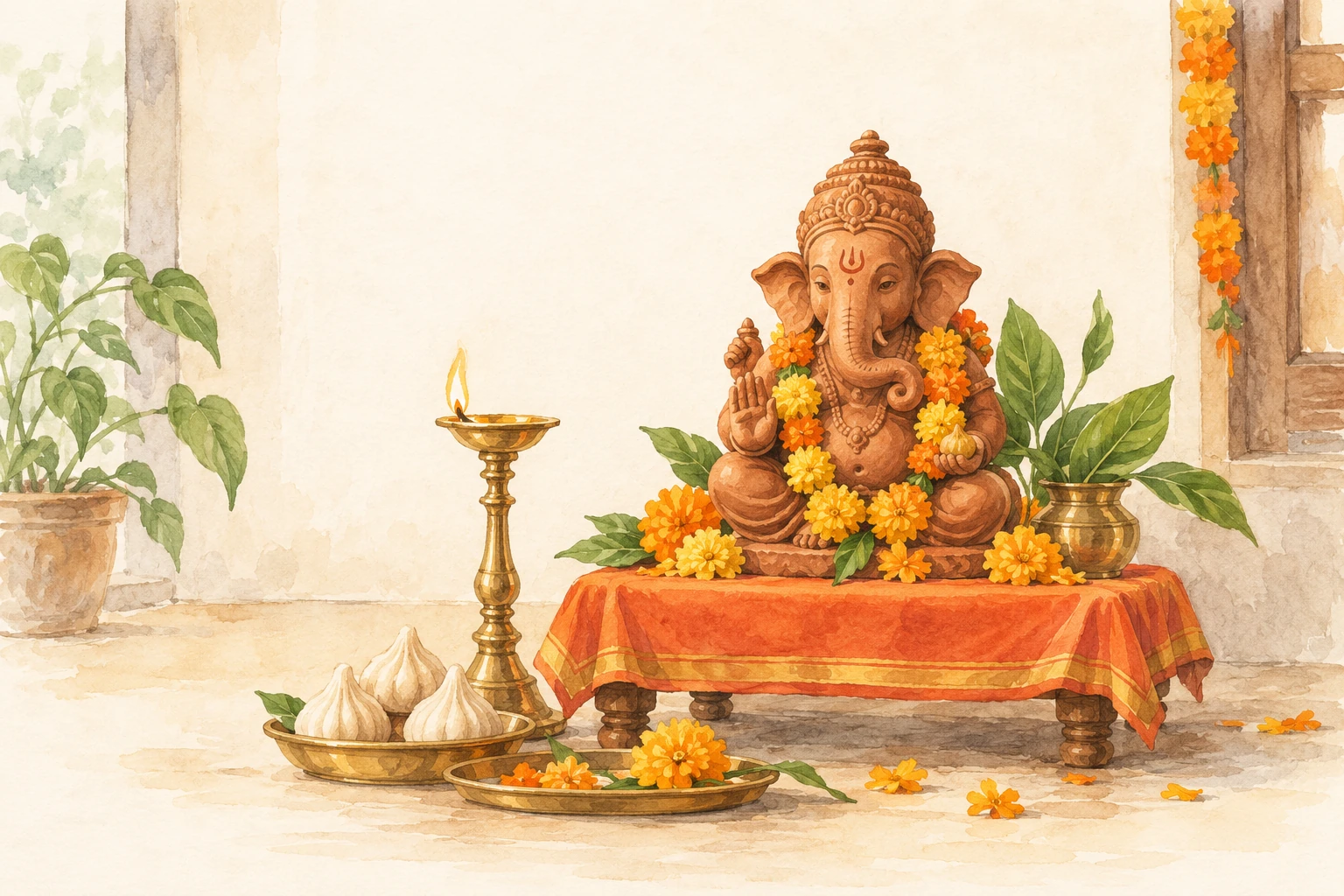
Featured Complete Guide
The illustrated DivineMandir guide covers story and significance, welcoming Ganesh Ji home, puja preparation, samagri, daily worship, offerings, visarjan, and 102 practical questions and answers.
Read Ganesh Chaturthi GuideBhadrapada Shukla Chaturthi; dates and installation or immersion duration vary by location, tithi, region and household tradition.
A multi-day Maharashtra and diaspora celebration, commonly concluding on Anant Chaturdashi. Permissions, crowds, sound and immersion rules are local.
A monthly Krishna Paksha Chaturthi; date, moonrise and completion time are location-specific.
Sankashti falling on a Tuesday, without claims of multiplied or guaranteed outcomes.
Magha Shukla Chaturthi in important Maharashtrian traditions, distinct from the Bhadrapada festival.
A Shukla Chaturthi observance whose naming and month emphasis vary by calendar, region and source.
A regional vrata in particular traditions; there is no single universal procedure.
Temple-specific festivals follow the authority calendar; Brahmotsava does not identify Brahma as the presiding deity.
Fasting is voluntary and should be adapted for health, age, work and climate. Avoid dehydration or pressure; seek appropriate medical advice when needed.
8 of 13
Formal rites may require a qualified officiant or lineage, a named textual method, venue authorization, fire and health safeguards, environmental care, and transparent arrangements.
Formal worship for auspicious commencement according to a named tradition—not a DIY fire-rite sequence.
An expanded formal rite in some institutions, without one universal online procedure.
Large-count recitation belongs to an organised context with transparent counting and welfare.
Pran-pratishtha or kumbhabhishekam concerns image or temple consecration and is not a household tutorial.
Installation belongs to named specialist traditions; operational directions are not provided.
9 of 13
Offer fresh, clean, sustainably sourced durva. Species, counts and bundle customs vary.
Use locally approved flowers, avoid protected species and follow temple rules.
Traditional sweets whose dairy, nuts, gluten and sugar should be considered; prepare and share hygienically.
Keep offerings fresh and modest; break coconuts only in an authorised safe area.
Use only where the tradition and temple permit, with approved materials that will not damage an image.
Use a stable, supervised ghee or oil lamp, or a safe electric alternative where appropriate.
Support students or libraries through transparent, dignified donation channels.
Choose verified channels, follow food-safety practices and avoid coercion or waste.
Prefer reusable clay or durable household murtis and authorised immersion systems. Avoid toxic materials, keep ritual waste out of waterways, manage sound and fire responsibly, and respect animal welfare and current local rules.
10 of 13
Maharashtra's Ganeshotsav customs are important, but they are not a template for every Ganesh temple or household tradition.
Ashtavinayak pilgrimage, household and public Ganeshotsav, Marathi aarti, Sankashti and Maghi Ganesh Jayanti follow local names, calendars and rules.
Pillaiyar and Vinayagar temples, kozhukattai, Chaturthi and Agama traditions retain their own contexts; Maharashtra procedures should not be imported automatically.
Maha Ganapati and Vinayaka kshetras, coastal traditions and Hampi icons require distinction between living worship and protected heritage.
Kanipakam and Vinayaka Chavithi practice follow Telugu calendars, current Endowments notices and local immersion rules.
Ganapathi homam, unniyappam and temple-tantra contexts are governed by temple, Devaswom and tantri authority, not generic online procedure.
Trinetra, Moti Dungri, Khajrana, Chintaman and other identities should retain local legend and current trust or district evidence.
Chavath includes family and village traditions whose privacy, food practices and image customs remain distinct.
Ganesh appears independently and within Durga-family festival iconography; western calendars and theology should not be assumed.
Kathmandu Valley Vinayaks and Newar sacred geography follow local names, guthi or temple authority and Nepal calendar context.
Temples and public processions retain regional languages and calendars while following local law, venue and community contexts.
11 of 13
These identities provide educational context. They are not a directory activation list and do not certify a temple detail guide.
Eight major Maharashtra Ganesh shrines with an established pilgrimage sequence.
An internationally known urban Ganesh temple.
A major identity in Pune's Ganeshotsav tradition.
A coastal swayambhu tradition in Ratnagiri associated with hill pradakshina.
A major Andhra Pradesh swayambhu Vinayaka kshetra and Brahmotsavam identity.
An ancient rock-cut Vinayagar image within a living Tamil Nadu temple.
A hill shrine within Tiruchirappalli's Rockfort sacred complex.
A historic Vinayagar temple identity in Puducherry's White Town.
Idagunji, Anegudde and Hattiangadi are distinct Ganapati sites whose legends should not be merged.
Madhur, Kottarakkara and Pazhavangadi belong to distinct Kerala temple systems.
A Rajasthan fort pilgrimage identity associated with a wedding-invitation custom.
Living diaspora institutions retain local regional languages, calendars and community settings.
12 of 13
Yes. A respectful image, safe lamp, water, flowers or durva, fruit and a public nama mantra are suitable; family tradition prevails.
“Om Ganeshaya Namah” is a concise public salutation. Counts are optional and pronunciation should be respectful.
No universal rule applies. Follow a reliable family, text or temple tradition and avoid waste.
Chaturthi is central; Tuesday or Wednesday emphasis varies regionally. No single weekday rule is universal.
A monthly Krishna-Paksha Chaturthi observance. Date, moonrise and completion time depend on location.
Restrictive fasting may be unsafe. Choose suitable food, prayer or service and seek medical advice where needed.
No. Duration, murti, food, ritual, procession and immersion differ by region, temple and household.
No. Devotion may encourage wisdom and disciplined effort; it cannot guarantee outcomes.
Simple prayer is open, but formal homa requires a qualified officiant, a named method and fire and health safeguards.
No. Verify the text, source and context; avoid unattributed extensions and guaranteed-result claims.
13 of 13
DivineMandir distinguishes scriptural sources, living temple and regional traditions, historical and heritage research, and current information from temple authorities.
Festival dates, temple timings, access, fees and local rules should be checked against current official sources before a visit.