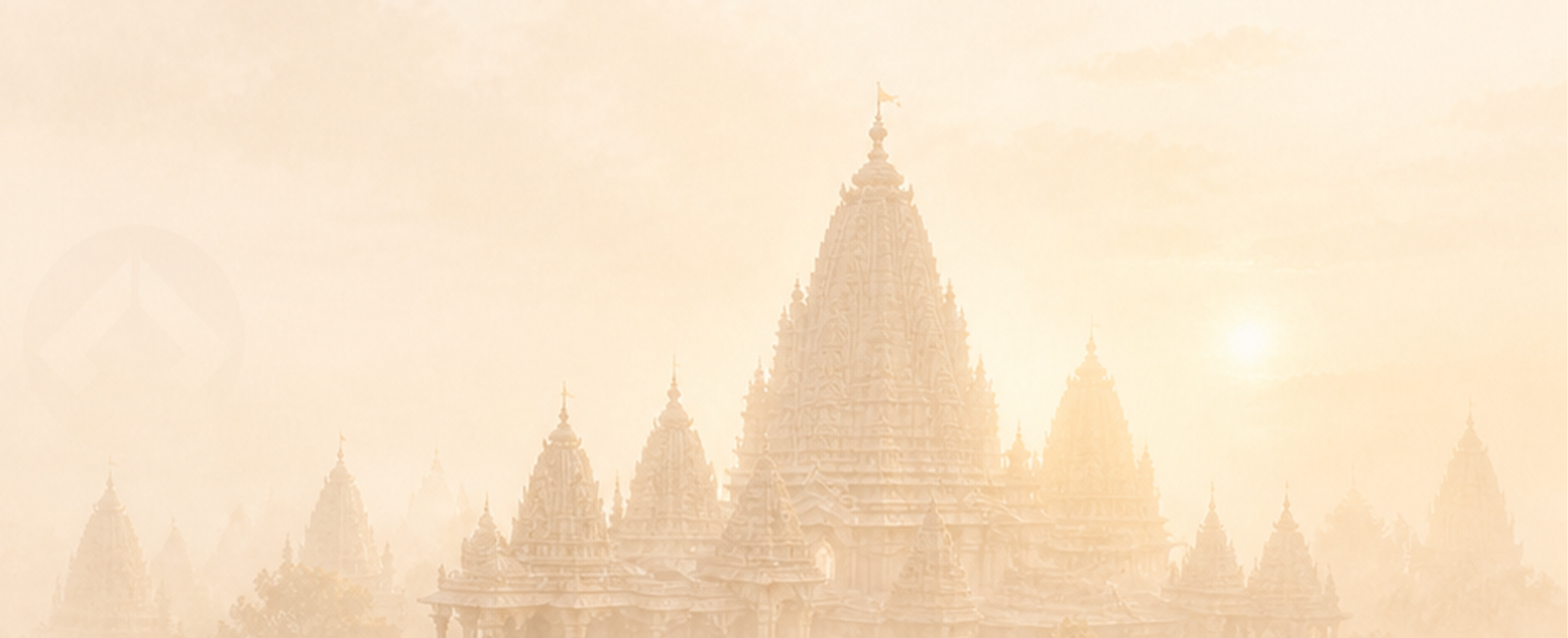
Vaikuntha Rama
Rama is represented with four arms bearing conch, discus, bow and arrow.
 Divine Mandir
Sree Seethaaramachandra Swamy Vaari Devasthanam, Bhadrachalam, Bhadradri Kothagudem District, Telangana 507111, India
Bhadrachalam’s Godavari-side shrine of four-armed Vaikuntha Rama with Sita and Lakshmana, shaped by the devotion of Bhakta Ramadasu.
Visitor note: October to March is generally cooler. Sri Rama Navami and Vaikuntha Ekadashi carry major devotional significance and larger crowds.
Source: DM-RM-003-TG.docx. Confirm current arrangements before travelling.
Bhadrachalam temple guide
Sri Sita Ramachandraswamy Temple stands on the Godavari at Bhadrachalam and is widely called Dakshina Ayodhya. Its sacred form is Vaikuntha Rama: a four-armed Rama holding the conch, discus, bow and arrow.
The sanctum context keeps Sita on Rama’s left lap and Lakshmana standing at his left. The source connects the site with Sage Bhadra, Pokala Damakka and the seventeenth-century devotee-composer Bhakta Ramadasu.
Sanctum identity
Four-armed Vaikuntha Rama holding conch, discus, bow and arrow.
Rama is represented with four arms bearing conch, discus, bow and arrow.
Sita is represented on Rama’s left lap and Lakshmana stands to his left.
Separate utsava forms of Rama, Sita and Lakshmana are used for daily worship and processions.
Temple identity in context
Temple tradition relates the hill to Sage Bhadra’s devotion.
The shrine is revered as a southern centre of Rama worship.
The river, ghats and Dandakaranya setting shape the pilgrimage context.
Tradition carefully framed
According to temple tradition, Vishnu appeared to Sage Bhadra as four-armed Rama with Sita and Lakshmana, and the hill became Bhadradri.
A second central tradition remembers Pokala Damakka’s rediscovery of the images and Bhakta Ramadasu’s temple building and devotional compositions.
Source-backed historical outline
Kancharla Gopanna, known as Bhakta Ramadasu, is credited with building the seventeenth-century temple and establishing enduring devotional traditions.
Ramadasu’s Telugu compositions remain closely associated with Bhadrachalam worship and festival culture.
Form, materials and setting
The temple follows a South Indian Dravidian arrangement.
The northern gateway has particular significance during Vaikuntha Ekadashi.
The source records steps leading to the main entrance.
Rama, Sita and Lakshmana form the central black-stone sacred image.
Mukha, Ranga and Kalyana mandapas support worship and festivals.
The river-facing setting connects the shrine with its pilgrimage landscape.
What makes this temple distinct
The Vaikuntha form distinguishes Bhadrachalam from more common two-armed Rama iconography.
The annual celestial wedding is the best-known public festival.
Music, story and worship preserve the memory of Bhakta Ramadasu.
The riverfront remains part of the wider visitor experience.
Choose the planning path that fits your visit.
Visit fit
Vaikuntha Rama darshan, Godavari pilgrimage and Telugu devotional heritage
Review guidanceSetting
Bhadradri hill and the Godavari River
Review guidanceBest period
October to March is generally cooler. Sri Rama Navami and Vaikuntha Ekadashi carry major devotional significance and larger crowds.
Review guidanceConfirm
Reconfirm timings, access, photography, offerings and festival controls before travel.
Review guidanceA source-supported visitor route; current directions take priority.
Approach the river and ghats with attention to current water and access conditions.
Climb the directed approach and take darshan of Sri Sita Ramachandra.
Visit source-described temple spaces connected with Bhakta Ramadasu.
Consider the regional Ramayana site only when transport and time allow.
Sree Seethaaramachandra Swamy Vaari Devasthanam, Bhadrachalam, Bhadradri Kothagudem District, Telangana 507111, India
Source-reported schedule; reconfirm before travel
5:00 AM–12:00 PM source-reported Sarva Darshan
3:00 PM–6:00 PM source-reported Sarva Darshan
6:30 PM–9:00 PM; closing rites follow
Temple schedules, festival access and local controls can change. Confirm the current programme with the responsible temple authority.
Principal source-listed celebrations
The annual Sita Rama Kalyanam is the principal celebration.
Vaikuntha Dwaram worship is central to this festival.
The larger annual festival cycle includes processions and temple rites.
Open public remembrance in Roman script
Shri Ram Jai Ram Jai Jai Ram
A public form of remembrance that may be recited quietly and respectfully.
Sita Ram
A concise public remembrance preserving the Sita-Rama couple context.
Simple, public and non-initiatory
Use a clean space and a calm, attentive approach.
Water, flowers, fruit or a safe lamp may be used when appropriate and permitted.
Use public Rama Nama in Roman script and close with quiet prayer.
Formal temple rites belong to trained priests and the responsible temple authority. This page does not publish initiated or operational ritual instructions.
Continue to the Lord Ram hub
Follow current temple rules
Offer only where the temple currently permits them.
Use temple-approved counters and directed offering points.
Prefer authorised temple channels and obtain a receipt when available.
Weather, festivals and crowds
October to March is generally cooler. Sri Rama Navami and Vaikuntha Ekadashi carry major devotional significance and larger crowds.
Weather, road conditions, queues and festival controls can change. Check close to the visit date.
Source-listed local and regional stops
Immediately beside the temple’s wider sacred landscape.
Open mapApproximately 35 km; associated in local tradition with Rama’s forest exile.
Open mapA regional Rama pilgrimage stop described in the source.
Open mapA regional nature extension from Bhadrachalam.
Open mapThe nearest principal rail-access town.
Open mapA longer Godavari landscape excursion requiring separate planning.
Open mapA practical, optional route
This route is optional. Reorder or shorten it according to time, current access and personal needs.
Before you enter
The supplied module sources used for this guide
DM-RM-003-TG.docx is the primary source for temple identity, traditions, worship, visitor planning and nearby places.
The derived catalogue supports public Roman-script mantras and safe household-worship framing.
Opening hours, access, photography, transport and festival arrangements can change; reconfirm them close to travel.