
CHAPTER 01
Understanding the Festival
Every welcome begins with understanding who we are inviting into our home.
01What is Ganesh Chaturthi, and why is it celebrated?
Ganesh Chaturthi celebrates the manifestation of Ganesh Ji, revered as the giver of wisdom and the remover of obstacles. Devotees welcome him with prayer, offerings and time together.
In practice. Begin with a sincere prayer for clear judgement, patience and the wellbeing of others. A home puja can be simple.
Meaning & story. Welcoming Ganesh Ji invites a fresh beginning in how we think and act.
Reference Maharashtra Tourism · Ganesh Chaturthi
Across traditions. The length of the celebration and household rituals differ across communities.
02Why is the festival also called Vinayaka Chaturthi or Ganeshotsav?
Vinayaka Chaturthi names the sacred lunar day associated with Vinayaka. Ganeshotsav means the celebration or festival of Ganesh and often refers to the wider period of festivities.
In practice. Use the name familiar to your family; these names do not require different deities or separate invitations.
Meaning & story. The names connect the same devotion with different Indian languages and customs.
Across traditions. Vinayaka Chavithi and Pillaiyar Chaturthi are also used in Telugu and Tamil settings.
03What do the names Ganesh, Ganapati, Vinayaka and Vighnaharta mean?
Ganesh and Ganapati mean the lord or leader of the ganas, the divine hosts. Vinayaka is understood devotionally as the guiding lord; Vighnaharta means remover of obstacles.
In practice. Choose a familiar name when praying, such as “Ganapati Bappa” or “Ganesh Ji”.
Meaning & story. Each name draws attention to an aspect of his presence: leadership, guidance or the clearing of difficulties.
Across traditions. Translations and theological explanations of Vinayaka differ; these are common devotional meanings.
04What is the story of Ganesh Ji's birth, and which scriptures describe it?
In the Shiva Purana narrative, Parvati creates a boy from material from her own body and appoints him to guard her doorway. His devotion to her command begins the familiar birth story.
In practice. Read this as a sacred narrative. The relevant sequence is in Rudra-samhita, Kumara-khanda, chapters 13–18.
Meaning & story. The story introduces a mother’s love and a child’s steadfast duty.
Reference Shiva Purana · birth narrative
Across traditions. Other Puranic traditions tell different accounts; do not combine them into a single supposedly historical event.
05How did Ganesh Ji receive his elephant head, and how do different traditional accounts explain this?
In the Shiva Purana account, a conflict with Shiva leads to the boy losing his head. He is restored to life with an elephant’s head. Other accounts explain his elephant form differently.
In practice. For children, describe the conflict briefly and focus on restoration, reconciliation and blessings.
Meaning & story. The elephant form becomes an enduring image of strength joined with wisdom.
Reference Shiva Purana · restoration of Ganesh Ji
Across traditions. This guide follows the Shiva Purana version; it does not present one account as the only Hindu tradition.
06Why is Ganesh Ji worshipped before beginning other pujas and auspicious activities?
Ganesh Ji is invoked first as the lord who helps devotees approach a task with wisdom and overcome obstacles. The Shiva Purana describes his elevation and the honour of first worship.
In practice. Pause before the ceremony, remember him and offer a short prayer before continuing.
Meaning & story. A mindful beginning asks us to act with humility and care.
Reference Shiva Purana · first-worship honour
Across traditions. The opening mantras and accompanying preliminary worship depend on the ritual tradition.
07What do his elephant head, large ears, broken tusk, trunk, large belly and mouse vehicle symbolise?
Common devotional readings associate the elephant head with wisdom, ears with attentive listening, trunk with adaptability, broken tusk with sacrifice, belly with acceptance and mouse with the restless desires we learn to govern.
In practice. Use the form as a family conversation: which quality can we practise today?
Meaning & story. These symbols can make an abstract value memorable.
Reference Devotional interpretation
Across traditions. These are interpretive teachings, not one fixed explanation prescribed identically in every scripture.
08What spiritual lessons does Ganesh Chaturthi teach devotees?
The festival can nurture gratitude, thoughtful beginnings, hospitality and a willingness to let go. Worship becomes meaningful when these values continue in daily life.
In practice. Let each family member choose one act: helping someone, listening patiently, sharing food or reducing waste.
Meaning & story. The celebration becomes a practice of generosity rather than a measure of spending.
Reference Practical household guidance
Across traditions. Families may connect these reflections with their own teacher’s guidance.
CHAPTER 02
History and Regional Traditions
A living tradition, carried through homes, temples and public celebrations.
09How did Ganesh Chaturthi celebrations begin, and what historical evidence is available?
Ganesh worship and household observances predate modern public Ganeshotsav. There is no securely established single “first celebration” that explains every region’s practice.
In practice. Distinguish old devotional traditions from the documented growth of organised public celebrations in the nineteenth century.
Meaning & story. The festival developed through many households, temples and communities.
Reference Maharashtra Tourism · Ganesh Chaturthi
Across traditions. Local temple and community histories may preserve their own milestones.
10How was the festival celebrated in homes and temples before large public celebrations developed?
Earlier celebrations included domestic worship, temple observances and patron-supported festivities. Large modern neighbourhood mandals grew from an already living religious tradition.
In practice. When telling this history, describe the setting—home, temple, court or public mandal—and cite a local record for specific dates.
Meaning & story. The public festival expanded an existing devotional life.
Reference Maharashtra Tourism · Ganesh Chaturthi
Across traditions. A Maharashtra-centred account does not describe the entire history of every region.
11What role did Lokmanya Tilak and other organisers play in expanding public Ganeshotsav?
Lokmanya Tilak helped popularise and mobilise public Ganeshotsav from 1893, connecting gatherings with social unity and public life under colonial rule. He did not originate the worship of Ganesh Ji.
In practice. Credit local organisers, artisans and mandals as well; avoid calling one person the inventor of the religious festival.
Meaning & story. A shared celebration also became a place for cultural expression and collective identity.
Reference Maharashtra Tourism · Ganesh Chaturthi
Across traditions. Accounts of the earliest public mandals differ; precise “first” claims need local archival evidence.
12How do celebrations differ across Maharashtra, Karnataka, Andhra Pradesh, Telangana, Tamil Nadu, Goa, Gujarat, Odisha and other regions?
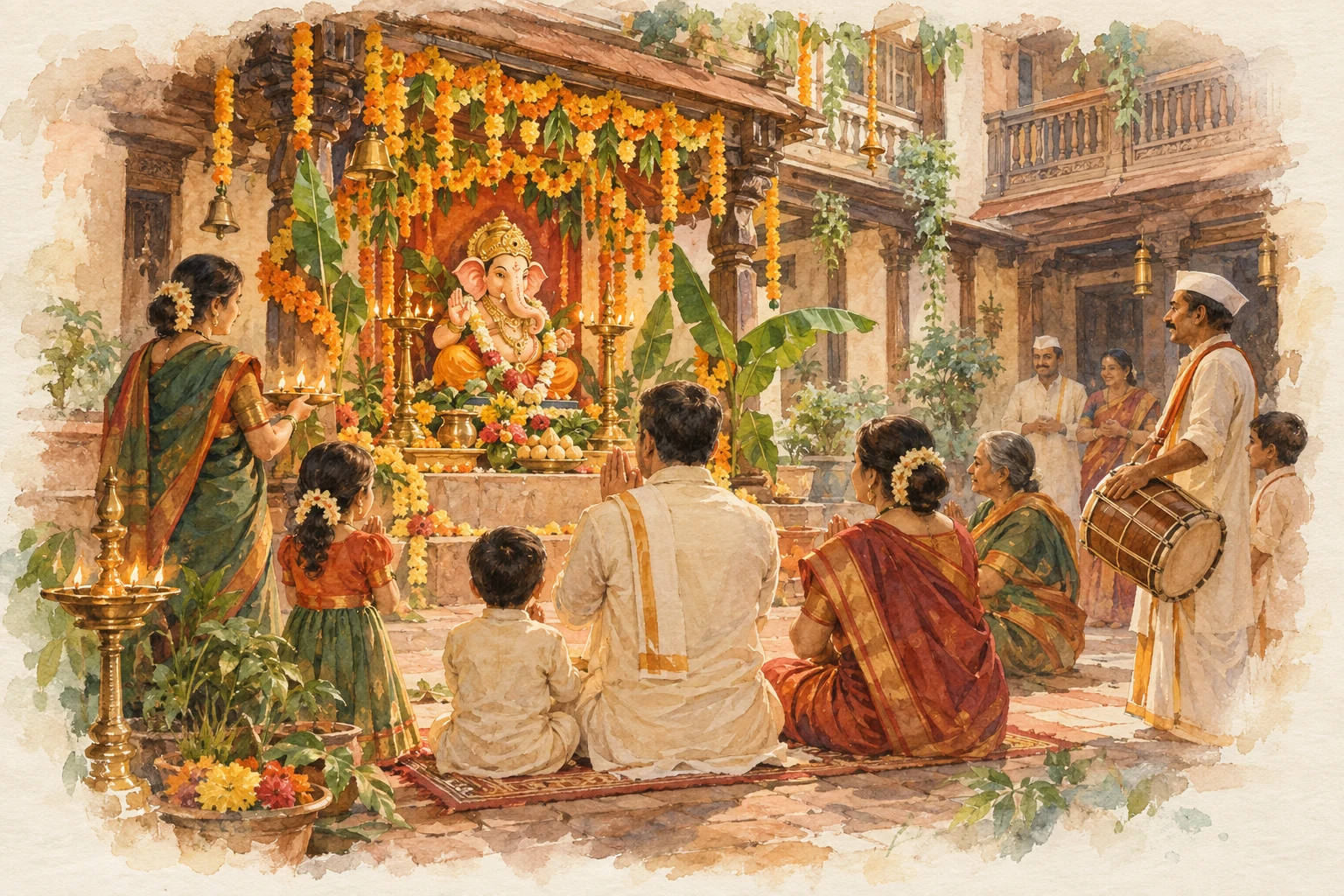
The shared centre is devotion to Ganesh Ji; the food, music, festival length and accompanying customs vary. The regional notes below are examples, not rules for every household.
In practice. Read the regional comparison and then follow the practice actually maintained by your family or chosen teacher.
| Region | Examples you may encounter |
|---|---|
| Maharashtra | Home and public mandal celebrations; modak, aarti and dhol-tasha in many public processions. |
| Karnataka | Gowri–Ganesha observances in many households, with local offerings and family customs. |
| Andhra Pradesh & Telangana | Vinayaka Chavithi, patra offerings, kudumulu or undrallu and nimajjanam. |
| Tamil Nadu | Pillaiyar or Vinayakar Chaturthi; kozhukattai and arugampul offerings in many homes. |
| Goa | Chovoth, family gatherings and a matoli or matov canopy of seasonal produce. |
| Gujarat | Household pujas and community pandals; offerings and celebration lengths vary. |
| Odisha | Ganesh Puja in homes and community settings, including many educational institutions. |
| Other regions & overseas | Local produce, temple guidance and practical immersion arrangements shape the celebration. |
Meaning & story. Regional variety is part of the festival’s richness.
Reference Goa Tourism · Chovoth · Maharashtra Tourism · Ganesh Chaturthi
Across traditions. Neighbours in the same town may observe the festival differently.
13Why does the celebration extend over several days, and how is it connected with Anant Chaturdashi?
An extended stay creates time for repeated worship and community gathering. The major concluding day is Anant Chaturdashi, which also has its own association with Vishnu in the Ananta form.
In practice. Choose the departure observance in advance and verify its calendar date rather than simply adding ten 24-hour days.
Meaning & story. Visarjan brings the temporary welcome to a grateful close.
Across traditions. Shorter home observances are common. Calendar counting and the popular phrase “ten-day festival” need not be identical.
14Which stories are especially associated with the festival, including Ganesh Ji and the moon?
Families often recount Ganesh Ji’s birth, his first-worship honour and the moon-related katha connected with Krishna and the Syamantaka jewel. These are sacred stories with distinct sources.
In practice. Choose one complete story and explain its lesson before moving to another.
Meaning & story. The moon katha is often read as a lesson in humility and the harm of ridicule or false accusation.
Across traditions. Story details vary between written versions and oral retellings.
CHAPTER 03
Determining the Date and Timing
Follow the lunar calendar—and the local clock where your puja takes place.

15How is the festival date determined each year?
The annual festival is associated with Bhadrapada Shukla Chaturthi—the fourth tithi of the waxing lunar fortnight. A panchang applies the relevant observance rules to choose the date.
In practice. Use the festival entry for the required year and location. Recheck annually.
Meaning & story. A lunar festival follows the Sun–Moon cycle rather than a fixed Gregorian date.
Across traditions. Calendar naming conventions and regional observance rules can differ.
16What is Chaturthi tithi, and why can its timings differ from a normal calendar day?
A tithi is a lunar phase interval, based on each 12-degree increase in the Moon’s angular separation from the Sun. It can begin or end during the civil day.
In practice. Read both the start and end times, including any next-day notation.
Meaning & story. This is why “Chaturthi” is not simply midnight to midnight.
Across traditions. Local time zones change the clock reading; the astronomical transition itself is one instant.
17How should a family find the appropriate puja muhurat for its own city?
Select your city and year in a reliable panchang, then read the Ganesh Chaturthi puja window displayed there.
In practice. Check location, time zone, festival date and any next-day label. For a formal ceremony, confirm the slot with your pandit.
Meaning & story. Local timing connects the observance with the place where it is performed.
Across traditions. Do not reuse another city’s screenshot or last year’s muhurat.
18Why is midday worship associated with Ganesh Chaturthi, and what can a family do if that timing is impractical?
Madhyahna, the middle portion of the daylight period, is traditionally preferred for the festival puja. It is not automatically the same fixed clock time in every city.
In practice. If work or care responsibilities make that difficult, ask your priest for a suitable alternative or perform a sincere simple home prayer when you can.
Meaning & story. The preferred time supports the observance; devotion need not become anxiety.
Across traditions. A specific vrata or formal ritual may have stricter timing guidance.
19What is the tradition concerning moon sighting, and how should its timing and meaning be explained?
Some traditions avoid seeing the moon during the festival’s specified period because of the moon-related katha. This is a religious observance, not a physical danger from moonlight.
In practice. Those following it should check the location-specific avoidance interval; do not assume the rule applies to the entire night.
Meaning & story. The custom recalls a story about pride, ridicule and reputation.
Across traditions. Many families follow it closely; others do not observe it.
20What guidance does that tradition give someone who accidentally sees the moon?
An accidental sighting need not cause fear. Within this tradition, devotees may remember Ganesh Ji and read or hear the Syamantaka-jewel story.
In practice. Continue the celebration calmly. A family priest can explain the customary prayer if you wish to follow it.
Meaning & story. The traditional response is remembrance and prayer, not an expensive corrective purchase.
Across traditions. Associated verses and practices vary; no harmful consequence should be presented as scientifically established.
CHAPTER 04
Preparing to Welcome Ganesh Ji Home
Choose a celebration that your family can sustain with attention and joy.
21What should a family know before welcoming Ganesh Ji home for the first time?
Begin with a manageable commitment: a suitable idol or existing image, a clean place, daily care and a clear plan for concluding the celebration.
In practice. Decide the duration, worship lead, daily responsibilities and immersion arrangements before shopping.
Meaning & story. Hospitality becomes easier when the family prepares together.
Reference Practical household guidance
Across traditions. Ask elders about an existing household custom, especially any explicit vow.
22Is bringing a new festival idol necessary, or can the family worship its existing Ganesh Ji idol or picture?
A new temporary idol is not essential for every household. An existing Ganesh idol or a respectful picture can be the focus of festival worship.
In practice. Continue the normal care of a permanent image. Do not treat it as a disposable festival idol.
Meaning & story. Devotion is directed to Ganesh Ji, not to acquiring a new object each year.
Reference Himalayan Academy · home worship
Across traditions. Installation and concluding rites differ for a newly invited festival image and an established home shrine.
23How should the family decide the duration of the celebration and the visarjan day?
Choose a duration you can support with regular care, in agreement with your family custom. Short observances and celebrations ending on Anant Chaturdashi both exist.
In practice. Confirm the actual farewell date before installation and include it in your plan.
Meaning & story. A realistic promise is easier to honour with attention.
Across traditions. Same-day, one-and-a-half-day, third-, fifth- and seventh-day departures occur in different traditions.
24What daily time, preparation and responsibilities should the family plan for?
Plan for preparation, worship, fresh offerings, cleaning and a safe conclusion each day. There is no universal number of minutes that makes devotion valid.
In practice. A household planning allowance might be 20–30 minutes morning and evening, with more time on installation and farewell days.
Meaning & story. Shared duties help the celebration remain calm.
Reference Practical household guidance
Across traditions. This time allowance is an example; a pandit-led ceremony can take longer.
25Can Ganesh Chaturthi be celebrated meaningfully with a small budget and a simple arrangement?
Yes. A clean altar, a familiar prayer and modest offerings can support a meaningful celebration.
In practice. Reuse vessels and cloth, choose seasonal offerings and spend within your means.
Meaning & story. Attention and generosity matter more than the scale of decoration.
Reference Himalayan Academy · home worship
Across traditions. A chosen formal puja may require additional items; confirm those before purchasing.
26What is a practical budget breakdown covering the idol, samagri, flowers, sweets, decorations and dakshina?
Set a spending cap first. The sample below allocates ₹3,000 for a small celebration; it is a planning example, not a quotation or a claim about current market rates.
In practice. Check local costs and the pandit’s agreed fee before booking. Reallocate the example amounts to fit your circumstances.
| Expense | Example allocation |
|---|---|
| Small idol | ₹600 |
| Samagri and lamp supplies | ₹350 |
| Flowers and durva | ₹200 |
| Sweets and fruit | ₹450 |
| Reusable decorations | ₹200 |
| Pandit / dakshina allowance | ₹900 |
| Contingency | ₹300 |
| Total example spending cap | ₹3,000 |
Meaning & story. Budgeting protects the household from pressure to overspend.
Reference Practical household guidance
Across traditions. For several days, add replenishment costs. A booked priest’s charge may exceed the sample allowance.
CHAPTER 05
Role of the Pandit
Good guidance helps everyone understand and take part in the ceremony.
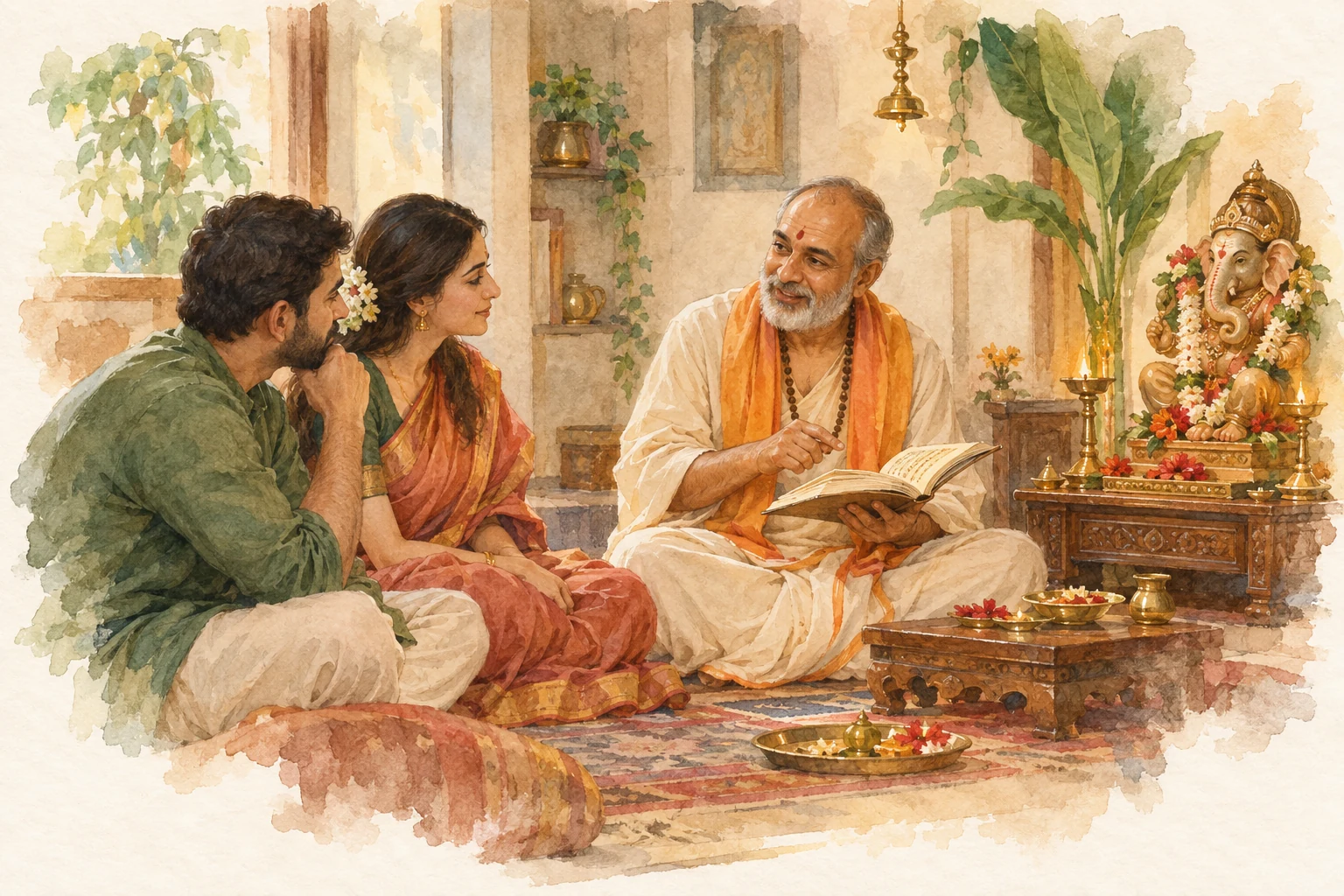
27Should we call a pandit, and which ceremonies particularly benefit from trained guidance?
A pandit is helpful for a formal installation, a detailed vrata, complex mantras or a family-specific ceremony. A simple household puja can be performed by devotees themselves.
In practice. Explain whether you want a short home puja or a full prescribed procedure, and agree on its scope beforehand.
Meaning & story. Guidance should help the family understand and participate.
Reference Himalayan Academy · home worship
Across traditions. Permanent temple consecration belongs to a different, specialist ritual context.
28Can family members perform a simple home puja themselves if they do not know Sanskrit?
Yes. A family can offer a simple prayer in a language it understands. Learning Sanskrit can enrich worship but need not prevent a sincere beginning.
In practice. Use the short mantra and simple sequence in Section XI. Speak slowly and keep its meaning in mind.
Meaning & story. Understanding brings the family into the ceremony.
Reference Himalayan Academy · home worship
Across traditions. Initiatory or specialist rites may require qualified instruction; this guide does not teach those.
29What should be confirmed with the pandit beforehand — tradition, timing, duration, samagri, charges and dakshina?
Confirm the date, local timing, ritual tradition, duration, language of explanation, family details, samagri responsibilities and total agreed cost.
In practice. Ask whether travel, assistants, materials and dakshina are included; also discuss rescheduling and payment terms.
Meaning & story. Clear arrangements let the household focus on the puja.
Reference Practical household guidance
Across traditions. Do not invent a gotra or other family detail; tell the priest when you do not know it.
CHAPTER 06
Choosing and Bringing Home the Idol
Choose the image with its care, transport and farewell already in mind.
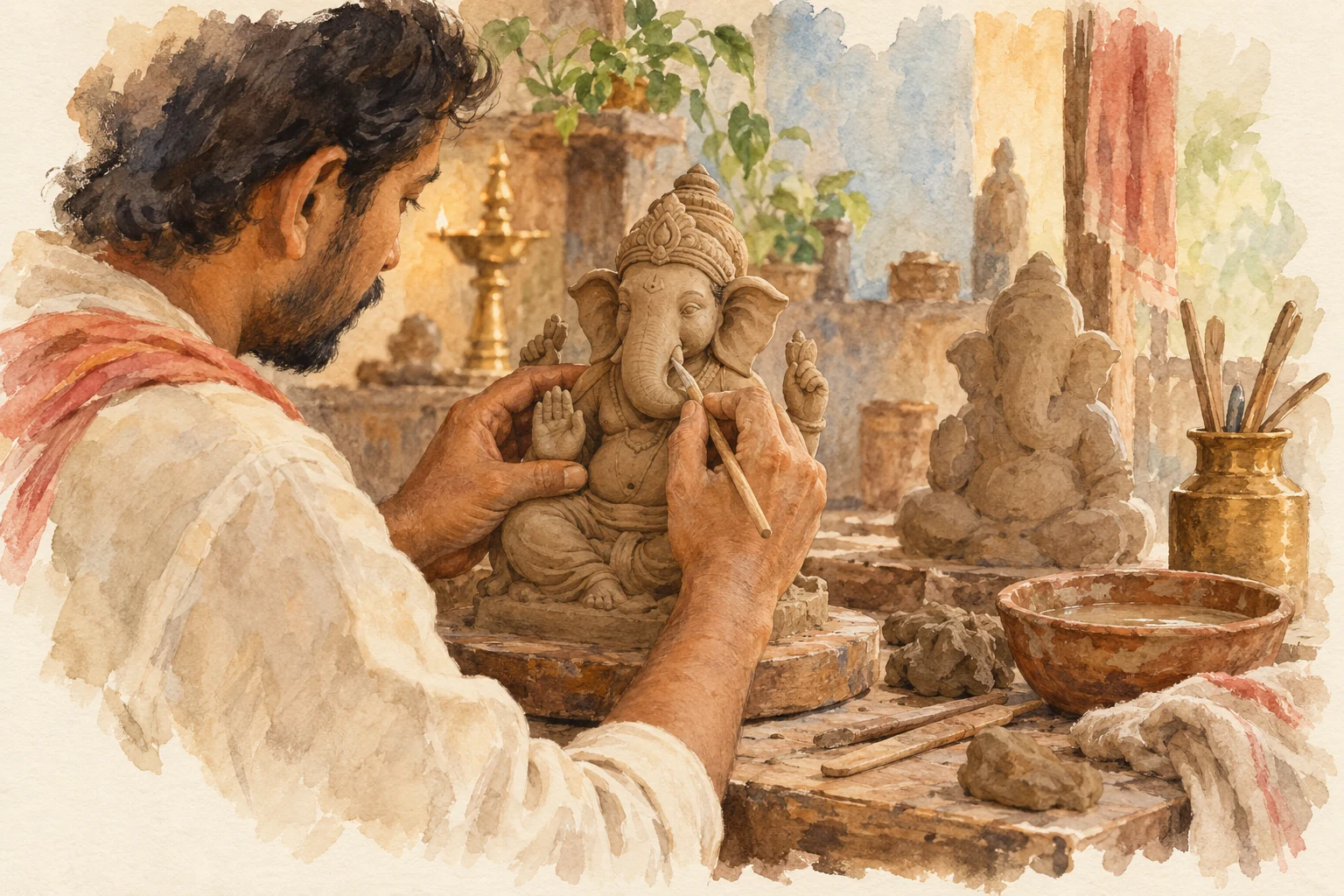
30How should we choose a Ganesh Ji idol for home worship?
Choose a respectful, stable image that you can carry, place and care for comfortably. Plan the idol and its eventual immersion together.
In practice. Measure your platform and immersion vessel before buying. Ask the maker about the material and finish.
Meaning & story. A modest idol can receive the same loving attention as a large one.
Reference Practical household guidance
Across traditions. Follow a specific inherited form if your family observes one.
31What idol material and size are suitable for the available space and planned visarjan method?
For home immersion, a small unfired natural-clay idol with a known non-toxic finish is practical. Fired terracotta, stone and metal do not soften like unfired clay.
In practice. A roughly 6–12 inch idol may suit a small household, but the base, weight and vessel dimensions matter more than a nominal height.
Meaning & story. Material choice determines how the image can be cared for and concluded.
Reference CPCB · idol-immersion guidance · Practical household guidance
Across traditions. The size range is practical advice, not a religious prescription.
32What are the environmental considerations when choosing between clay, Plaster of Paris, and natural-colour idols, and how does this affect visarjan?
Unfired clay can soften and disperse in water. Plaster of Paris behaves differently; paints, glitter, varnish and mixed fillers can complicate disposal even when an idol is labelled “eco-friendly”.
In practice. Ask what both the body and coating contain. Choose a known material and check local immersion instructions before purchase.
Meaning & story. Respectful celebration includes care for shared water and soil.
Reference CPCB · idol-immersion guidance
Across traditions. Current state and municipal directions govern local arrangements; a national guidance document is not a substitute for them.
33What significance is attached to the idol's posture and trunk direction, and which recommendations are tradition-specific?
A seated form is common in homes. Some traditions attach special worship requirements to a right-curving trunk, but popular shopping advice is not a universal rule.
In practice. If a particular form carries ritual obligations in your tradition, discuss them before buying. Otherwise choose a dignified image you can care for.
Meaning & story. The form should support confidence and devotion.
Reference Practical household guidance
Across traditions. Trunk direction must be described from the deity’s own viewpoint.
34What should be checked before purchasing the idol, including damage, material and paint?
Inspect the base, joints, surface and any loose attachments. Confirm whether the idol is unfired clay, fired clay, plaster or a mixture, and ask about coatings.
In practice. Lift it only with permission and support the base. Keep the seller’s material and care information.
Meaning & story. Good inspection prevents avoidable handling damage.
Reference Practical household guidance
Across traditions. Do not judge environmental suitability from colour or weight alone.
35When should the idol be brought home, and can it be brought before Ganesh Chaturthi?
An idol may be brought home before the festival so that preparations are unhurried. Bringing it home and performing the formal festival installation need not be the same event.
In practice. Keep it securely in a clean, designated place until the planned worship.
Meaning & story. Preparation gives the welcome time and attention.
Reference Practical household guidance
Across traditions. Some households observe a separate arrival muhurat; confirm that custom locally.
36How should the idol be carried and transported respectfully and securely?
Support the entire base with both hands or a stable board, and keep the idol upright. Never lift it by the trunk, crown, arms or ornaments.
In practice. Use cushioning in transport, secure the base and keep another person free to open doors.
Meaning & story. Careful handling is a simple form of respect.
Reference Practical household guidance
Across traditions. Processional customs may add music or chanting, but secure transport remains essential.
37Is covering the idol during transport a required practice or a regional custom?
Covering the idol during transport is a custom in some families, not an established universal condition for home worship.
In practice. If following it, use a light clean cloth without catching delicate parts or blocking the carrier’s view.
Meaning & story. The gesture can mark the transition from bringing the image to formally welcoming it.
Reference Practical household guidance
Across traditions. Ask your family elder or priest whether the custom belongs to your own observance.
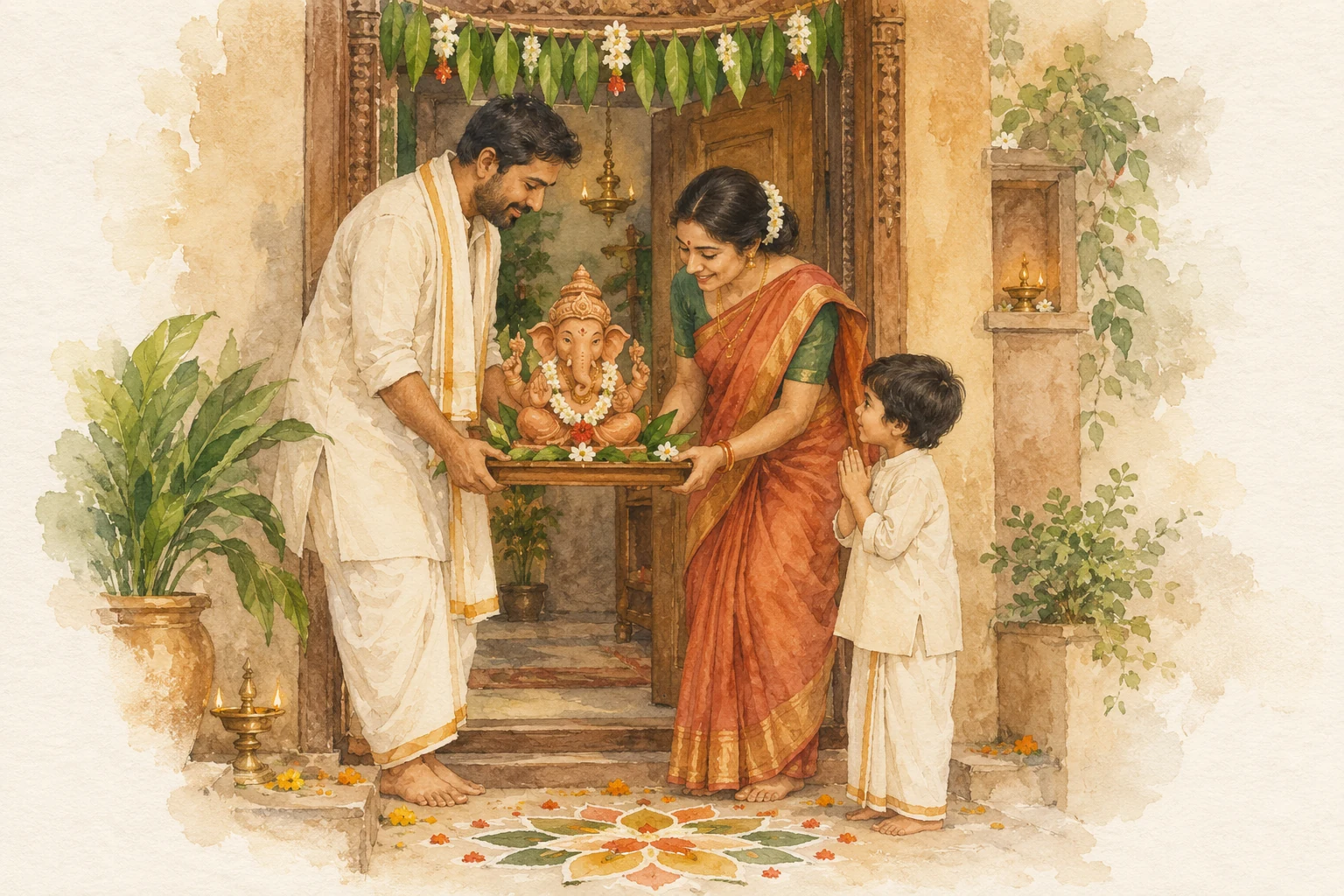
38How should the family welcome Ganesh Ji at the entrance before placing him in the puja area?
Bring the idol through a clear entrance with a calm welcome and place it on the prepared platform. A short prayer or family aarti may accompany the arrival.
In practice. Set the idol securely before handling a flame; avoid juggling aarti and a heavy image at the threshold.
Meaning & story. The welcome expresses hospitality and affection.
Reference Practical household guidance
Across traditions. Threshold aarti, rangoli and specific welcoming gestures vary regionally.
CHAPTER 07
Preparing the Home and Puja Space
Make room for stillness, comfortable participation and a safe flame.
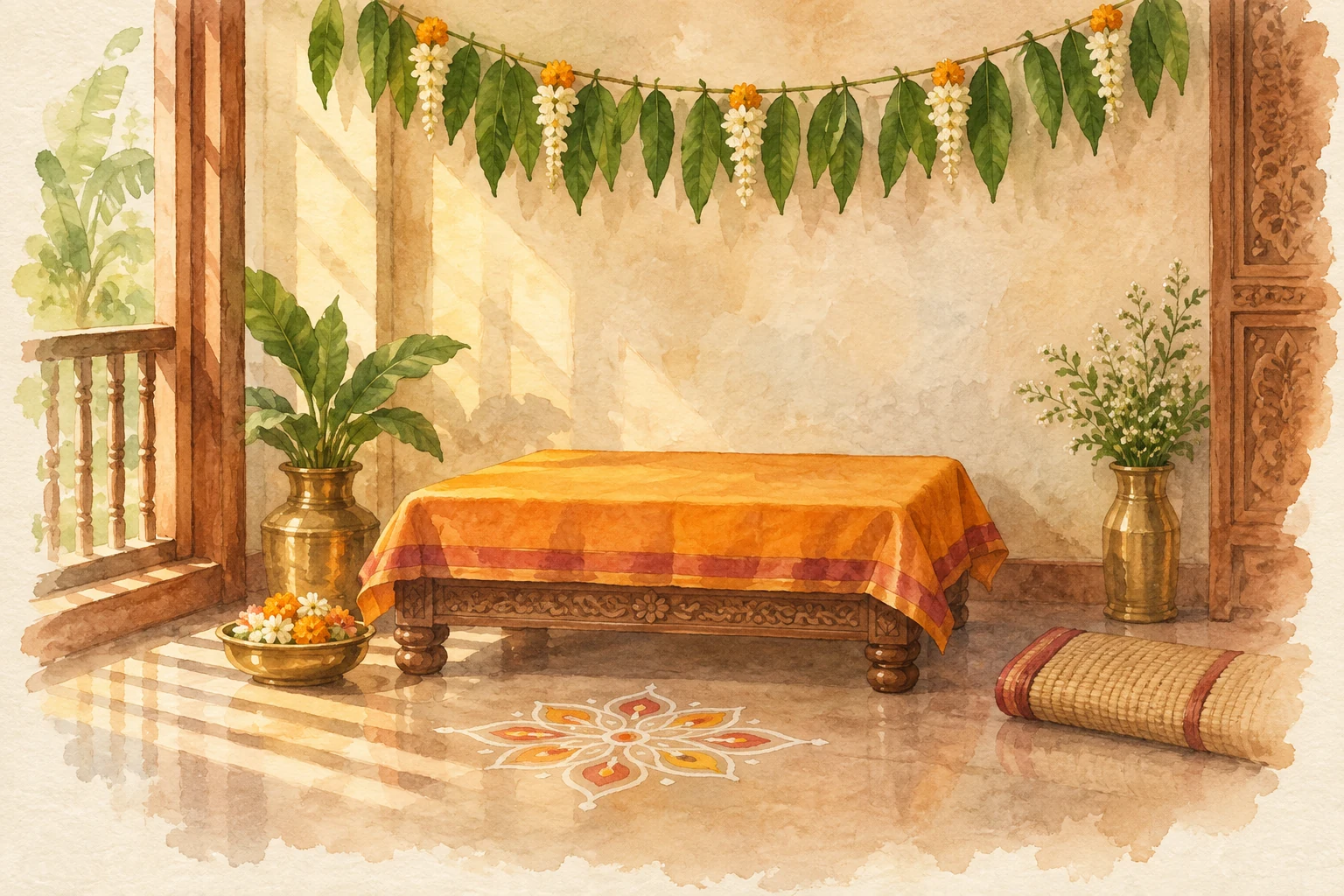
39How should the home and puja space be prepared before the idol arrives?
Clean the worship area, vessels and cloth before arranging the altar. Keep a clear route for carrying the idol and space for everyone to sit comfortably.
In practice. Prepare the offerings and set aside cleaning cloths, a waste bowl and drinking water before guests arrive.
Meaning & story. An orderly space helps people remain attentive.
Reference Practical household guidance
Across traditions. Additional purification customs can follow the household tradition.
40Which room or area is suitable, and how should a small apartment accommodate the puja?
Choose a clean, quiet and well-ventilated part of the home with a stable surface. A separate puja room is helpful but is not necessary for a simple observance.
In practice. In a small apartment, use a secure table or chowki away from door swings, cooking splashes and busy walking routes.
Meaning & story. A modest corner can become a place of concentrated attention.
Reference Practical household guidance
Across traditions. Established shrine arrangements may take precedence over general placement suggestions.
41Does the building floor matter, and should the idol stand on a raised chowki or pedestal?
An upper-floor apartment is not, by itself, a barrier to worship. The physical altar should be stable, clean and at a height that allows safe, comfortable access.
In practice. Use a chowki or secure table; raise it beyond a child’s reach where necessary. A chair is suitable for anyone who cannot sit on the floor.
Meaning & story. A raised support expresses care and protects the image.
Reference Practical household guidance
Across traditions. No universal building-floor number or mandatory pedestal height is established here.
42Which direction should the idol face, and which direction should the person performing puja face?
A common home practice is for the devotee to face east or north. In a face-to-face arrangement, an east-facing devotee looks towards a west-facing idol; a north-facing devotee towards a south-facing idol.
In practice. Check direction from where you actually sit. Keep the arrangement safe and workable before applying optional placement advice.
Meaning & story. Direction can support a family’s ritual discipline without causing confusion about whose viewpoint is used.
Reference Practical household guidance
Across traditions. Vastu recommendations and priest-led arrangements differ; this is a common convention, not a universal mandate.
43What cloth should cover the chowki, and do particular colours have a traditional significance?
Use a clean cloth that fits the platform without loose fabric near flames. Red, yellow and saffron are common festive choices.
In practice. Secure the cloth and keep the idol’s base level. Reuse a clean cloth when suitable.
Meaning & story. Colour expresses celebration; cleanliness and steadiness matter more than decorative expense.
Reference Practical household guidance
Across traditions. Preferred colours follow family or regional practice; one colour is not compulsory for every home.
44How can the space be decorated while keeping the idol accessible and lamps safely positioned?
Use a restrained arrangement of flowers, reusable fabric or paper decoration, leaving room for offerings and aarti.
In practice. Keep garlands and hanging décor clear of lamps. Run electrical cables along protected edges rather than across the sitting area.
Meaning & story. Decoration should frame the worship and allow people to participate.
Reference Practical household guidance
Across traditions. Regional decorations can be added without copying every element of a public pandal.
45What safety precautions should the family take regarding fire (lamps, agarbatti, camphor), electrical decorations, and children near the puja setup?
Keep flames on a heat-resistant surface away from cloth, paper and children. Use sound electrical fittings and keep water away from sockets and lighting connections.
In practice. Assign an adult to lamps and camphor, avoid overloaded extension boards and extinguish flames before leaving or sleeping.
Meaning & story. Caring for people is part of caring for the celebration.
Reference Practical household guidance
Across traditions. A ritual preference for continuous light never justifies an unattended fire.
CHAPTER 08
Puja Samagri List
Gather what your chosen puja needs, and keep the preparation simple.
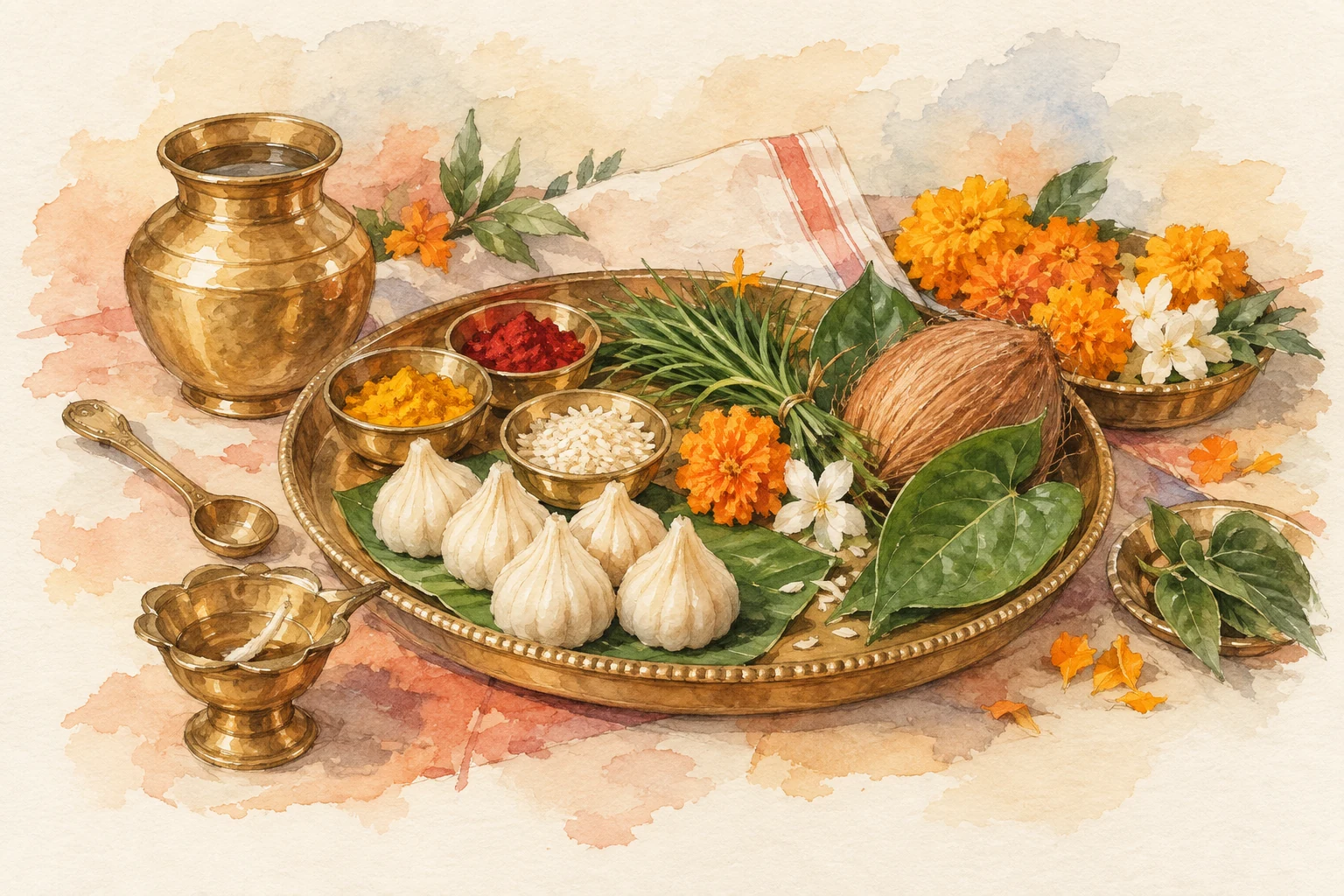
46What is the complete puja samagri list, with quantities for one household?
The household list below is a starting quantity guide for a simple puja for about 4–6 people. It separates reusable items, daily offerings and optional formal-ritual additions.
In practice. Check existing supplies first, then confirm additions with your pandit. Increase food for guests and replenish perishables as needed.
| Item | Starting quantity | Use / status |
|---|---|---|
| Ganesh image or suitable festival idol | 1 | Existing image or temporary idol, as chosen |
| Stable chowki / table, cloth and sitting support | 1 each | Reuse clean household items |
| Clean water, cup and spoon | About 1 litre; 1–2 cups; 1 spoon | For ritual use; keep drinking water separate |
| Offering / working plates and a used-water bowl | 2–3 plates; 1 bowl | Separate food from used ritual materials |
| Diya, cotton wicks, ghee or suitable lamp oil | 1–2 lamps; 5–10 wicks; about 50 ml | Starting supply, not a continuous-lamp estimate |
| Sandalwood paste, kumkum / turmeric | Small containers, about 10–20 g each | Use only those in your method; protect the surface |
| Akshata: unbroken uncooked rice | About 50 g | Plain or prepared as your tradition directs |
| Fresh flowers / small garland | A small plate / 1 garland | Choose available suitable flowers |
| Clean durva | A small bunch | Count or bundle according to your procedure |
| Sweets and seasonal fruit | Enough for 4–6 people | Separate offering portion; 21 only if following that custom |
| Incense and stable holder | 2–4 sticks or a small amount | Optional in a simple puja; ventilate |
| Aarti plate, bell, clean cloth | 1 each | Reusable; bell optional for a simple prayer |
| Kalash, leaves and coconut | 1 set if prescribed | Optional for the simple route |
| Cloth for the image, sacred thread / mauli | 1 small set if prescribed | Symbolic offerings can be used where appropriate |
| Panchamrit ingredients | Small amounts of milk, curd, ghee, honey and sugar | Only if prescribed; avoid bathing a fragile idol |
| Betel leaves, areca nut, coins / dakshina | As agreed for your procedure | Formal-ritual additions; areca nut is not a children’s snack |
| Twenty-one patra set | Only if following that procedure | Identify correctly; keep all ritual leaves away from food |
| Immersion vessel / local collection plan | 1 appropriate arrangement | Decide before purchasing the idol |
Meaning & story. Buying with a list keeps preparation calm and limits waste.
Reference Practical household guidance
Across traditions. These quantities are practical suggestions, not prescribed religious minimums.
47Which items are essential for the chosen puja method, and which are optional or specific to a tradition?
For a simple home observance, the core is a respectful image, a clean place, water, a modest offering and sincere prayer. Lamps, incense, flowers and other customary items can enrich it.
In practice. Mark the list for your chosen method. A kalash, panchamrit, sacred thread, full patra set or elaborate clothing may belong to a fuller procedure.
Meaning & story. The list should serve the puja you intend to perform.
Reference Practical household guidance
Across traditions. Do not assume an item optional in a simple prayer is optional in a specific vowed rite.
CHAPTER 09
Flowers, Leaves and Offerings
A flower, a blade of grass, a sweet: small offerings with a place in the story.
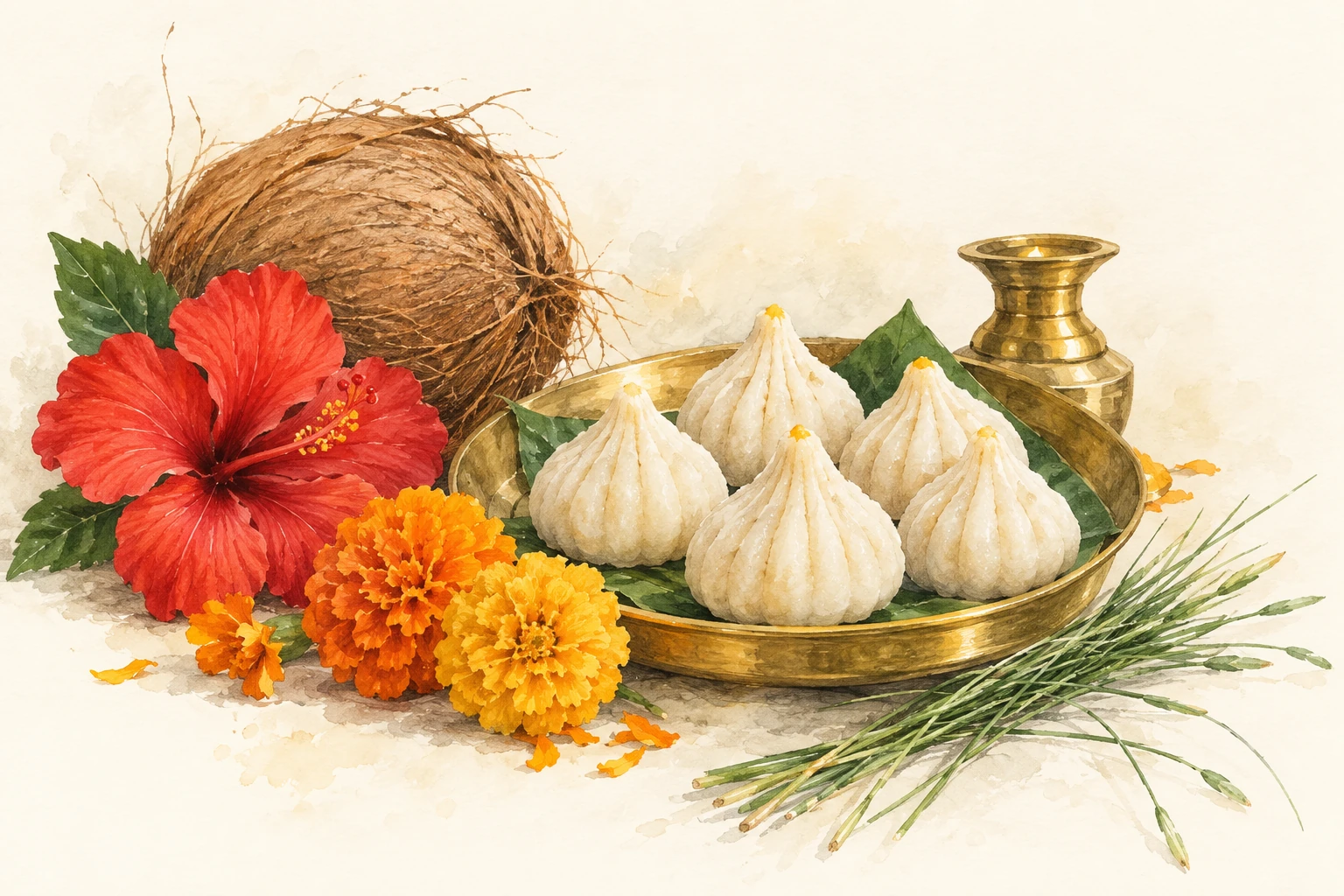
48Which flowers should be offered to Ganesh Ji, and why are they used?
Fresh hibiscus, marigold and other suitable local flowers are commonly offered. Red flowers have a particular association with Ganesh worship in several traditions.
In practice. Choose clean, fresh flowers and remove plastic ties. Offer them gently near the feet or on an offering plate.
Meaning & story. Flowers express affection, beauty and the giving of something fresh.
Reference Himalayan Academy · Ganesh worship and meaning
Across traditions. Tamil practice may include erukku flowers; local custom determines the choice.
49What is durva grass, how can it be identified, and what story or symbolism explains its offering?
Durva is the fine grass commonly identified as Cynodon dactylon, also called doob or arugampul. It grows with creeping stems and narrow blades; a sketch alone is not enough for reliable identification.
In practice. Obtain known clean puja grass and rinse it. Do not pick unfamiliar or chemically treated grass.
Meaning & story. A popular oral story says durva cooled Ganesh Ji after he subdued Analasura; it is a devotional explanation, not a medical claim.
Across traditions. Bunching, blade counts and the way it is offered vary.
50Which leaves are used in traditions that perform a special leaf offering, and what does each represent?
Some traditions offer twenty-one kinds of leaves with twenty-one names of Ganesh Ji. Each offering is addressed to a named aspect of the deity; a separate fixed symbolism for every plant is not established.
In practice. Use the name-and-leaf reference below with your priest’s list. Obtain plants from a knowledgeable supplier; ritual leaves are not automatically edible.
| Leaf / traditional name | Ganesh name invoked |
|---|---|
| Shami | Sumukha |
| Bhringraj | Ganadhisha |
| Bilva | Uma-putra |
| Durva | Gajamukha |
| Badari / ber | Lambodara |
| Datura | Hara-sunu |
| Tulsi* | Shurpakarna |
| Sem | Vakratunda |
| Apamarga | Guhagraja |
| Kantakari | Ekadanta |
| Sindoor leaf | Heramba |
| Tejpatra | Chaturhotra |
| Agastya | Sarveshvara |
| Kaner | Vikata |
| Kadali / banana | Hematunda |
| Arka | Vinayaka |
| Arjuna | Kapila |
| Devadaru | Vatu |
| Marua | Bhalachandra |
| Gandhari | Suragraja |
| Ketaki | Siddhivinayaka |
*Tulsi appears in this particular sequence; see the next answer for the exception. The name is the dedication of each offering. Do not assume every leaf has a universally agreed separate symbolic meaning.
Meaning & story. The sequence honours Ganesh Ji through diversity in nature.
Across traditions. Lists and botanical identifications vary. Do not ingest datura, oleander or arka, and keep them away from food and children.
51What is the tradition concerning Tulsi in Ganesh worship, and are there regional exceptions?
Tulsi is generally omitted from everyday Ganesh worship in many traditions. Some specific twenty-one-leaf procedures include it, so a blanket statement that there are no exceptions is inaccurate.
In practice. For a basic home puja, leave it out unless your priest’s or family’s procedure explicitly includes it.
Meaning & story. The exception belongs to a particular ritual context.
Across traditions. Textual instructions differ; follow one coherent tradition.
52Which sweets should be offered, and why are modak and laddoo associated with Ganesh Ji?
Modak and laddoo are well-loved Ganesh offerings. A modest portion of a suitable sweet or fresh fruit can also be offered in a simple household puja.
In practice. Prepare or buy a clean vegetarian offering and place it in a dedicated dish before anyone begins eating from it.
Meaning & story. The sweetness is often interpreted as the joy of devotion and wisdom.
Reference Ganapati Atharvashirsha · offerings
Across traditions. The sweet chosen and its ingredients vary across India.
53What stories explain Ganesh Ji's association with modak?
Popular devotional retellings describe modak as a treasured sweet or a reward associated with wisdom. Versions involving Parvati and her sons circulate, but there is no single verified origin story for every regional modak custom.
In practice. Tell a named version as a traditional story; avoid attaching an unverified Purana chapter number.
Meaning & story. A sweet inner filling is often used as a teaching image for inner joy.
Reference Practical household guidance
Across traditions. This symbolic reading is devotional interpretation rather than a compulsory ritual explanation.
54How do regional offerings such as modak, kozhukattai and kudumulu differ?
Ukadiche modak commonly has a steamed rice-flour shell with coconut and jaggery filling. Tamil kozhukattai includes sweet and savoury steamed forms. Telugu kudumulu can refer to several rice-based steamed offerings, including unfilled or savoury forms.
In practice. Use your family recipe; the same regional name can cover more than one preparation.
Meaning & story. Local grain and cooking traditions give a familiar form to the offering.
Reference Practical household guidance
Across traditions. Fried, milk-based and other festival versions exist; these foods are not all identical recipes.
55Which fruits and other foods are offered, and what is the significance of coconut, banana and other customary items?
Bananas, coconut and available seasonal fruits are common offerings. In devotional explanations, breaking a coconut can symbolise letting go of ego; fruit expresses gratitude for nourishment.
In practice. Wash produce, use a clean offering plate and break coconut safely away from the idol.
Meaning & story. An offering turns everyday food into an act of gratitude.
Reference Ganapati Atharvashirsha · offerings
Across traditions. These symbolic readings vary. Costly fruit or a fixed variety count is not necessary for every simple puja.
56Why do some traditions specify offerings in a count of 21, and when is that count customary?
Twenty-one appears in several Ganesh offering traditions, including durva, leaves or sweets. Symbolic explanations differ; it is not a universal arithmetic requirement for all forms of prayer.
In practice. Follow the count if it belongs to the procedure you have chosen; otherwise offer a modest available quantity.
Meaning & story. Repetition can provide rhythm and concentration.
Across traditions. Do not present one popular explanation of 21 as the only scriptural meaning.
57Can sweets be purchased, or should they be homemade — and what alternatives suit ingredient shortages or dietary needs?
Both a carefully prepared homemade sweet and a suitable shop-bought sweet can be offered in a simple home observance.
In practice. Check vegetarian ingredients, freshness and allergies. Use fruit or a suitable rice-based preparation when milk, nuts or another ingredient is unsuitable.
Meaning & story. Care in choosing the offering expresses hospitality.
Reference Practical household guidance
Across traditions. Some households keep stricter kitchen rules; dietary adaptations can be discussed before the festival.
58What respectful substitutes can be used when a flower, leaf, sweet or other puja item is unavailable?
For a simple puja, offer what is respectfully available: a suitable flower, clean water, fruit or a short prayer. Do not collect an unknown plant just to complete a list.
In practice. If performing a specific vrata, ask the pandit about substitutions. Note unavailable items before the ceremony.
Meaning & story. Sincerity is helped by thoughtful preparation, not panic shopping.
Reference Practical household guidance
Across traditions. A general household substitute is not automatically a substitute in every formal rite.
CHAPTER 10
Arranging the Puja Items
Keep every offering within reach, and the space around Ganesh Ji clear.
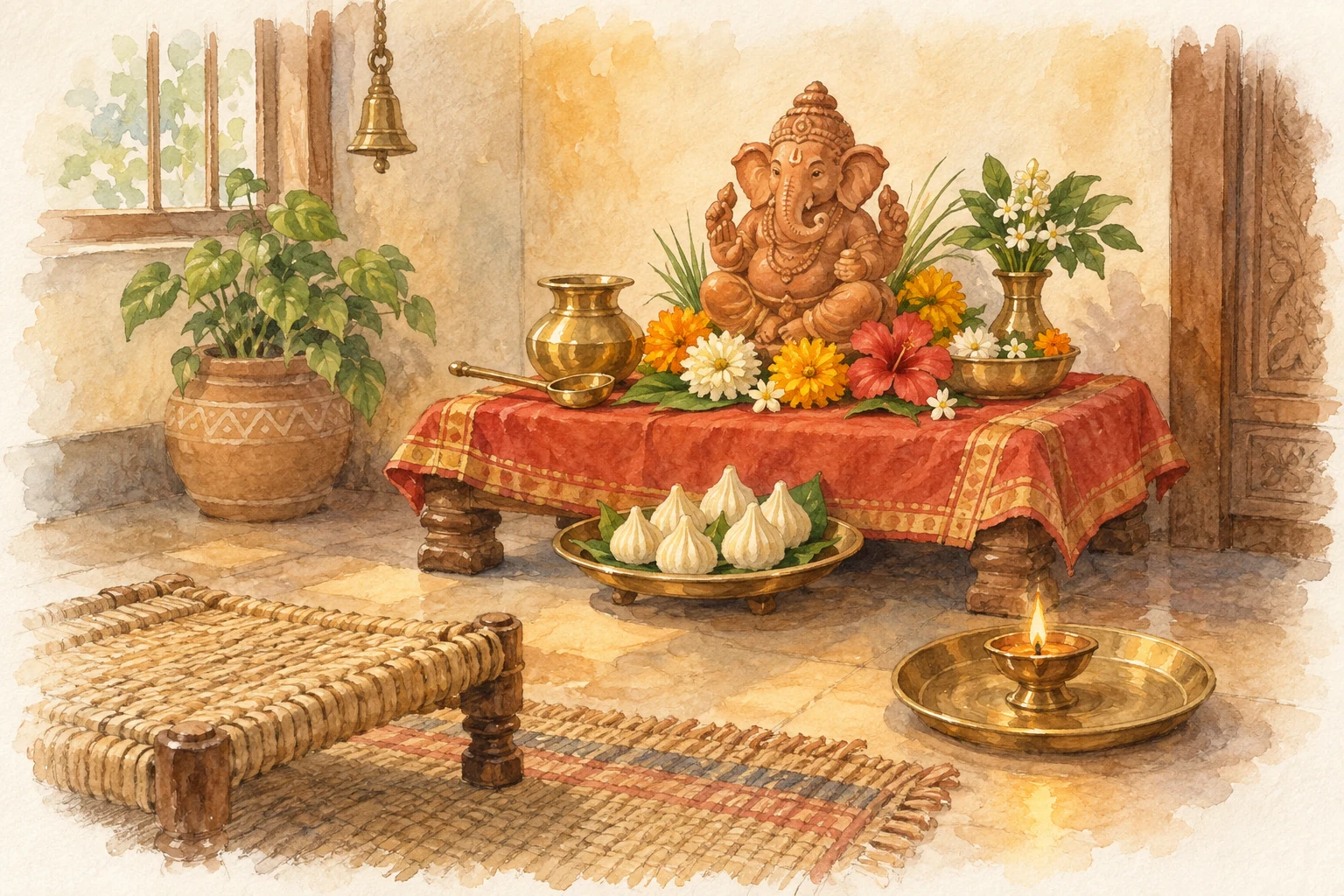
59How should all puja items be arranged before the ceremony begins?
Arrange the altar before starting, with the idol secure at the rear centre and working trays within easy reach. Separate food, powders, water and flame.
In practice. Group items in order of first use, using the labelled layout below. Keep spare supplies on a side table.
Meaning & story. An uncluttered arrangement lets attention stay with worship.
Reference Practical household guidance
Across traditions. This layout is an illustrative household arrangement, not a universal ritual map.
60Where should the idol, kalash, diya, incense holder, bell, water vessels, flowers and food offerings be placed?
Keep the idol on its raised support; put the optional kalash beside it. Place water, flowers and preparation trays towards the front, with a clear central space for the food offering.
In practice. Keep the lamp and incense on a separate heat-resistant side surface. Keep the bell reachable without passing an arm across the flame.
Meaning & story. Position follows respectful visibility and safe access.
Reference Practical household guidance
Across traditions. A priest may change the sides to suit the chosen method and available space.
61When describing an item as being on the "left" or "right," is that from the devotee's viewpoint or the deity's?
In this guide, “left” and “right” in the altar diagram mean the devotee’s left and right while facing Ganesh Ji.
In practice. For any instruction using the deity’s viewpoint, state that explicitly; the two viewpoints reverse each other.
Meaning & story. Clear language prevents accidental confusion.
Reference Practical household guidance
Across traditions. Trunk descriptions normally use the deity’s own left or right, unlike this layout diagram.
62Is a kalash required for the chosen method, and how should its water, leaves and coconut be arranged?
A kalash is included in many fuller procedures, but is not required for every simple home prayer. It commonly contains clean water, leaves around the mouth and a coconut above.
In practice. Use a stable vessel. Add the number of leaves and any other contents specified by your procedure; keep the coconut secure.
Meaning & story. The vessel is often understood as a symbol of life, abundance and sacred presence.
Reference Practical household guidance
Across traditions. Five mango leaves are common, but leaf counts, contents and placement differ.
63Which items belong on the main altar, and which should remain on separate preparation or offering trays?
The main altar needs the image and a modest amount of decoration. Working trays should hold the items you pick up, while spare packets and utensils stay on a side table.
In practice. Keep food covered until offering; keep used ritual water in its own bowl, away from edible prasad.
Meaning & story. Separation prevents spills and keeps the shrine visually calm.
Reference Practical household guidance
Across traditions. A larger formal altar may include additional deities or ritual vessels under guidance.
64Can the arrangement be shown in a labelled diagram, with each item numbered in its order of use?
Yes. The labelled plan below shows one practical arrangement from the devotee’s viewpoint. Numbers indicate first use in the simple sequence, not a compulsory sacred position.
In practice. The lamp is used again for light offering and aarti. Water also returns at several stages. Keep the optional kalash outside the numbered sequence unless your procedure uses it.
Meaning & story. A visual guide helps the family prepare together.
Reference Practical household guidance
Across traditions. Adapt the layout for handedness, access and your priest’s instructions.
CHAPTER 11
Performing the Puja
Move gently from intention and welcome to offerings, light and gratitude.
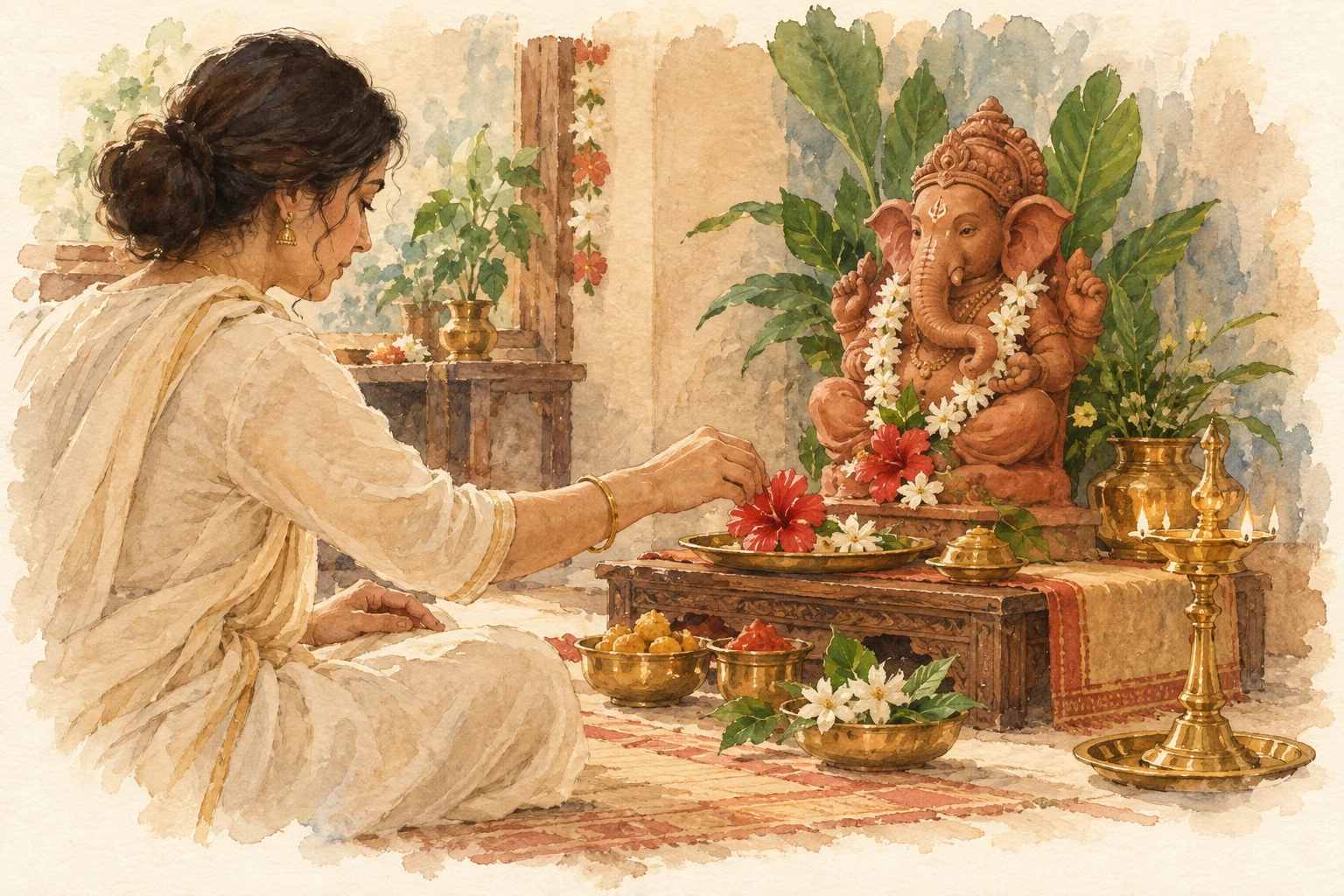
65What should devotees do immediately before starting the puja?
Wash or bathe as circumstances allow, wear clean comfortable clothes and sit steadily. Have all materials ready and take a quiet moment before beginning.
In practice. Silence unnecessary notifications, confirm who will read the prayer and check that lamps stand securely.
Meaning & story. Preparation settles the mind as well as the room.
Reference Practical household guidance
Across traditions. Dress and personal-preparation customs differ; physical limitations can be accommodated.
66What is the complete puja sequence, from the opening preparation to the final prayer?
A full household sequence moves from preparation and sankalpa to invocation, offerings, prayer, aarti and closing gratitude. The expanded sequence below makes these stages easy to follow.
In practice. Read it once before starting. Use the simple route if that is the observance you have chosen; consult your priest for a formal vrata.
- PrepareClean the altar, arrange materials and make the lamp safe.
- BeginLight the lamp; settle yourself; perform customary personal purification.
- SankalpaState your name and sincere intention.
- InvokeRemember Ganesh Ji; perform avahana and festival installation as applicable.
- Offer a seat and waterProceed through the welcome services in your chosen manual.
- Bathe and adornUse symbolic bathing for fragile clay; offer cloth and thread if prescribed.
- Offer fragrance and flowersApply only suitable marks; offer akshata, flowers and durva.
- Pray and listenChant a familiar mantra; read the katha or hymn if included.
- Offer incense, light and foodKeep flames secure and food separate from ritual residues.
- Aarti and reverenceOffer the final light, namaskar and appropriate pradakshina.
- Close and shareExpress gratitude, ask forgiveness for omissions and distribute prasad.
- Continue the stayBegin the daily routine; reserve the festival farewell for the agreed day.
Meaning & story. The pattern resembles welcoming and honouring a cherished guest.
Reference Traditional offering vocabulary · Sanskrit reference
Across traditions. The number and grouping of steps differ between manuals; follow one complete procedure.
67What is a sankalpa, and how can someone state it if they do not know their gotra?
Sankalpa is the statement of intention for the puja: who is praying, where and for what wholesome purpose.
In practice. A simple example is: “I, [name], with my family, offer this Ganesh Chaturthi puja with devotion, for wisdom and the wellbeing of all.” If your gotra is unknown, say so; do not invent it.
Meaning & story. Intention gives direction to the ceremony.
Reference Practical household guidance
Across traditions. A pandit-led sankalpa usually includes more calendar and family details.
68What do avahana, sthapana and prana pratishtha mean, and how does temporary home worship differ from permanent temple consecration?
Avahana is invocation; sthapana is placing or establishing the image for worship; prana pratishtha refers to invoking divine presence through consecratory rites.
In practice. For a new festival idol, use the household procedure taught by your priest. Do not repeat a permanent image’s consecration merely because a festival arrives.
Meaning & story. The terms describe related but distinct ritual actions.
Reference Traditional offering vocabulary · Sanskrit reference
Across traditions. A temple’s permanent consecration follows specialised Agamic or other ritual traditions and cannot be replaced by this short guide.
69What is Shodashopachara Puja, and what does each of its sixteen offerings signify?
Shodashopachara means sixteen services or offerings. The table below gives one widely used grouping, from invocation and a seat through water, adornment, fragrance, light, food and reverence.
In practice. Treat the table as an explanation of the structure; use the exact grouping in your priest’s manual during the ceremony.
| Service | Meaning |
|---|---|
| 01 · Avahana | Invocation |
| 02 · Asana | A seat |
| 03 · Padya | Water for the feet |
| 04 · Arghya | A respectful water offering |
| 05 · Achamaniya | Water for ritual sipping |
| 06 · Snana | Bathing |
| 07 · Vastra | Clothing |
| 08 · Yajnopavita | Sacred thread |
| 09 · Gandha | Fragrance / sandalwood |
| 10 · Pushpa | Flowers |
| 11 · Dhupa | Incense |
| 12 · Dipa | Light |
| 13 · Naivedya | Food |
| 14 · Tambula | Betel offering |
| 15 · Nirajana | Waving of light |
| 16 · Namaskara / pradakshina | Reverence and circumambulation |
Meaning & story. Each service expresses an aspect of sacred hospitality.
Reference Traditional offering vocabulary · Sanskrit reference
Across traditions. Some manuals separate or combine garments, ornaments, betel, aarti and concluding reverence differently.
70What is a simpler home-puja method for a beginner?
A beginner can clean the altar, light a safe lamp, state an intention, remember Ganesh Ji, offer water and a flower, offer food, pray and conclude with aarti or namaskar.
In practice. Use “Om Gam Ganapataye Namah” slowly. Keep the ceremony short enough to perform attentively.
Meaning & story. A familiar repeated prayer can make worship accessible to the whole family.
Reference Ganapati Atharvashirsha · name-mantra
Across traditions. This is a simple devotional method, not a replacement for the requirements of a specific vow.
71How should ritual bathing be performed when the idol is made of clay or has a delicate painted surface?
Do not pour water, milk or panchamrit over an idol that may soften, stain or be damaged. A symbolic offering of a few drops into a separate vessel can be used with suitable guidance.
In practice. Ask the maker about the surface. Keep the image dry when uncertain and offer bathing mentally or symbolically.
Meaning & story. The intention of service should include care for the image.
Reference Practical household guidance
Across traditions. A durable metal or stone image may have a different bathing procedure; check its finish too.
72In what sequence should water, clothing, sacred thread, sandalwood, kumkum, akshata, flowers and durva be offered?
A common order is water-related services and symbolic bathing, then drying or garments and sacred thread, followed by sandalwood or other prescribed marks, akshata, flowers and durva.
In practice. Offer small quantities, using a plate when direct application would damage the image. Keep loose rice and powders away from food.
Meaning & story. The progression moves from welcome and refreshment to adornment.
Reference Traditional offering vocabulary · Sanskrit reference
Across traditions. Kumkum, turmeric, sindoor and sacred-thread use depend on the procedure and image.
73Which mantras should be recited at each stage, and can their pronunciation and meaning be provided in simple language?
For a simple home puja, a short Ganesh name-mantra can accompany each offering. The table below provides plain-Roman offering phrases and English meanings.
In practice. Say “Om Gam Ganapataye Namah” slowly: “Om; gam; ga-na-pa-ta-ye; na-mah.” This is a pronunciation aid, not an exact phonetic transcription.
Om Gam Ganapataye Namah
For a simple offering, say the name-mantra, then the phrase below. These are brief conventional offering phrases with original plain-English meanings, not a full consecration text.
| Stage | Plain-Roman phrase | Meaning |
|---|---|---|
| Remember Ganesh Ji | Om Gam Ganapataye Namah | Reverence to Ganapati |
| Invoke | Avahayami | I invoke / welcome you |
| Offer a seat | Asanam samarpayami | I offer a seat |
| Water for the feet | Padyam samarpayami | I offer water for the feet |
| Respectful water offering | Arghyam samarpayami | I offer arghya |
| Ritual sipping water | Achamaniyam samarpayami | I offer water for ritual sipping |
| Symbolic bath | Snanam samarpayami | I offer a bath |
| Cloth | Vastram samarpayami | I offer clothing |
| Sacred thread | Yajnopavitam samarpayami | I offer a sacred thread |
| Sandalwood | Gandham samarpayami | I offer fragrance |
| Unbroken rice | Akshatan samarpayami | I offer akshata |
| Flowers | Pushpani samarpayami | I offer flowers |
| Durva | Durvankuran samarpayami | I offer durva shoots |
| Incense | Dhupam aghrapayami | I offer incense fragrance |
| Light | Dipam darshayami | I show the light |
| Food | Naivedyam nivedayami | I present the food offering |
| Aarti | Nirajanam samarpayami | I offer the waving of light |
| Bowing | Namaskaram samarpayami | I offer reverence |
Meaning & story. The meaning is an offering of reverence to Ganapati.
Reference Ganapati Atharvashirsha · name-mantra
Across traditions. Use teacher-guided pronunciation for longer Vedic or initiated mantras; the table is a simple devotional aid.
74Which Ganesh katha, stotra or prayer may be read, and at what point in the puja?
A family may read the festival katha, a familiar Ganesh stotra or a devotional hymn it understands. The Ganapati Atharvashirsha is also recited in many traditions.
In practice. A convenient home arrangement is to read after the main flower offerings and before food offering or aarti.
Meaning & story. Listening gives the ceremony a shared meaning.
Reference Ganapati Atharvashirsha · name-mantra
Across traditions. The position of reading varies; longer recitations benefit from a reliable text and pronunciation guide.
75When and how should incense, the lamp and naivedya — the food offering — be presented?
After adornment and flowers, many procedures offer fragrance through incense, then light, then food. Aarti may be a distinct concluding act.
In practice. Use minimal smoke, keep burning items upright and place the food on a clean plate. Offer water alongside it as your procedure directs.
Meaning & story. Fragrance, light and nourishment become forms of service.
Reference Traditional offering vocabulary · Sanskrit reference
Across traditions. Dhoop, agarbatti and camphor are not all necessary in every simple home puja.
76How is Ganesh Ji's aarti performed, and which aarti may the family use?
During aarti, devotees offer light while singing or reciting a familiar prayer. Hold the lamp steadily and move it in gentle clockwise circles before the image.
In practice. Use a secure plate, leave generous distance from decoration and let an adult handle the flame. Family members can join seated.
Meaning & story. The light expresses reverence and attention.
Across traditions. Jai Ganesh Deva and Sukhkarta Dukhharta are familiar choices in different regions; exact circling counts vary.
77How should pradakshina, namaskar and the closing prayer be performed?
Conclude with respectful circumambulation where there is safe space, a bow or joined palms, gratitude and a prayer for forgiveness for unintended omissions.
In practice. Walk clockwise if doing pradakshina. In a small room, remain seated and offer namaskar; do not squeeze past a flame.
Meaning & story. The closing returns attention to humility and gratitude.
Reference Practical household guidance
Across traditions. Counts and forms of prostration differ. Mobility limitations do not prevent respectful prayer.
78When does the offered food become prasad, and how should it be distributed?
Food offered devotionally is received as prasad after the offering and its customary conclusion. Share it with clean hands or serving utensils.
In practice. Set aside edible food before ritual water or powders can contact it. Refrigerate perishable food promptly and avoid waste.
Meaning & story. Sharing extends the offering into hospitality.
Reference Practical household guidance
Across traditions. The exact moment and serving customs follow the household procedure; painted-idol bathing water is not drinking water.
CHAPTER 12
Managing a Permanent and Festival Idol Together
The festival image receives a special welcome; daily devotion continues.
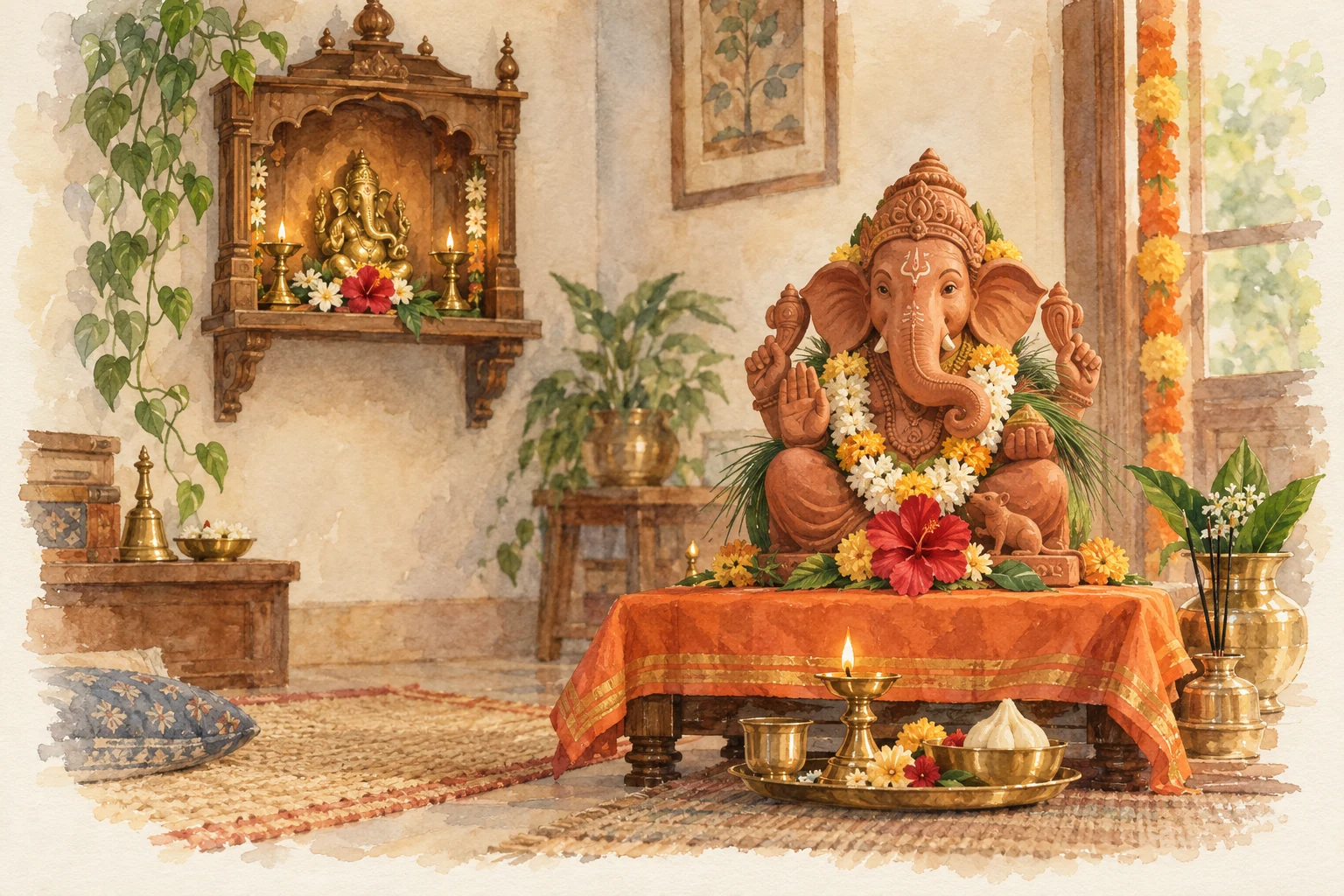
79If the family already has a permanent Ganesh idol in their home mandir, how should it be handled during the days the temporary festival idol is present?
Keep the permanent Ganesh idol in its established place and continue its usual care while welcoming the temporary festival image separately.
In practice. Make enough space to worship both respectfully. You may offer prayers and prasad to both; reserve the festival farewell and immersion for the temporary image.
Meaning & story. The festival adds a special observance without displacing the household’s continuing devotion.
Across traditions. If a permanent image has formal consecration requirements, follow its existing priestly guidance.
CHAPTER 13
Daily Worship During the Festival
The days between welcome and farewell are held together by small acts of care.
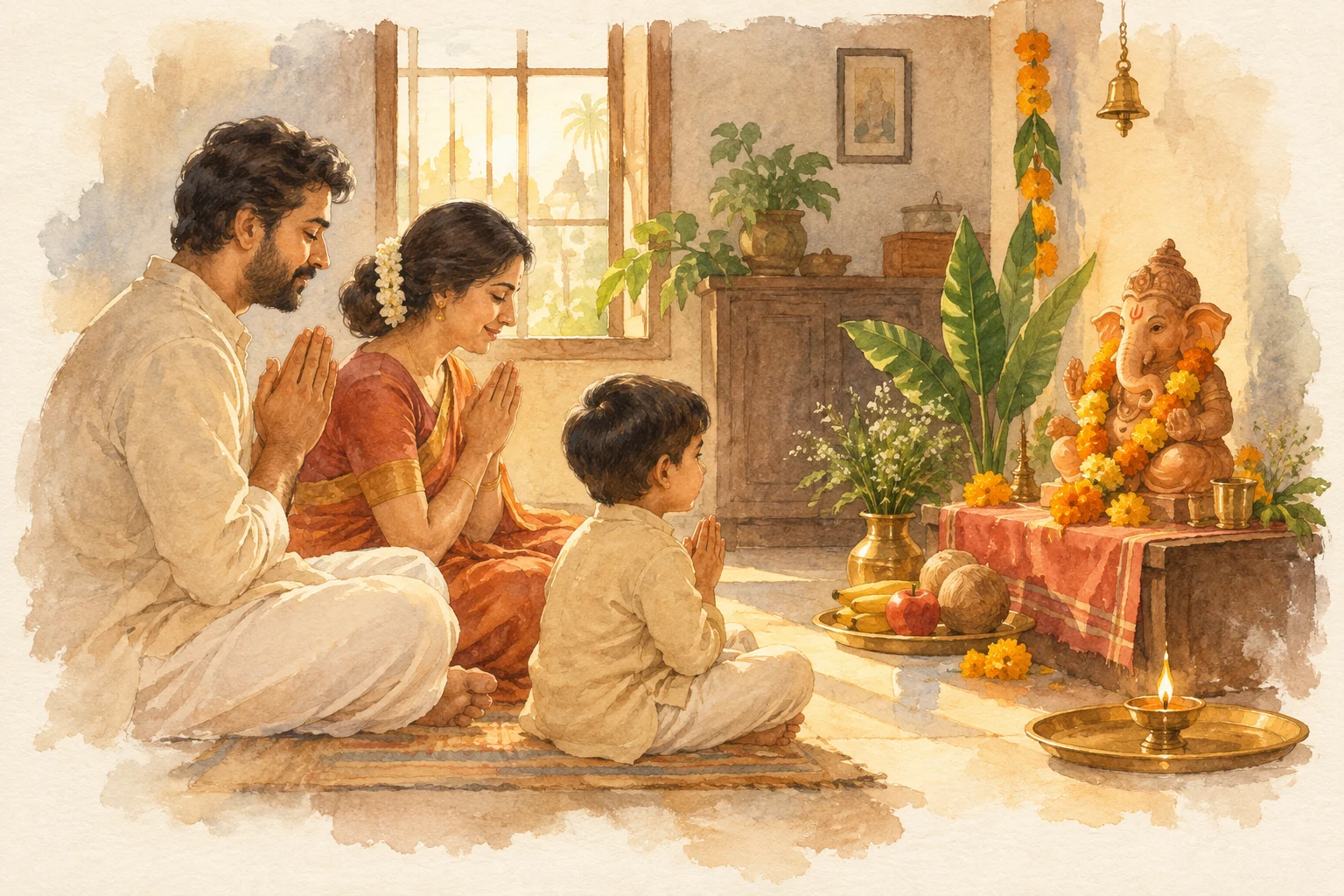
80What daily worship should continue while Ganesh Ji remains at home?
Continue a manageable rhythm of prayer, fresh offerings and cleanliness for the agreed period of the stay.
In practice. Set a morning and evening time, share duties and ensure someone checks the altar and perishable offerings.
Meaning & story. Daily repetition turns an initial welcome into sustained care.
Reference Practical household guidance
Across traditions. The length and detail of worship should match your family’s chosen observance.
81What should the morning and evening routine include, and how does it differ from installation-day puja?
Daily worship is usually shorter than installation-day worship. It may include a clean altar, lamp, flowers, a food offering, a familiar prayer and aarti.
In practice. In the morning refresh the setup; in the evening gather briefly, pray and leave the area safe before sleeping.
Meaning & story. Consistency helps the festival remain part of family life.
Reference Practical household guidance
Across traditions. Do not automatically repeat the initial installation or consecration rites each day.
82How often should water, flowers and food offerings be replaced, and how should the altar be cleaned?
Refresh drinking-quality offering water daily, remove wilted flowers and keep edible offerings fresh. Replace anything spoiled or contaminated sooner.
In practice. Move used flowers into a separate collection bowl. Wipe around the image gently without shifting it unnecessarily.
Meaning & story. Cleanliness expresses continuing attention.
Reference Practical household guidance
Across traditions. There is no universal hourly replacement schedule; climate and food type matter.
83Is fasting necessary, what forms does it take in different traditions, and when is it concluded?
Fasting is part of some Ganesh Chaturthi vrata traditions, but every family member need not undertake the same fast to participate in worship.
In practice. Decide beforehand whether your observance permits fruit, a restricted meal or another pattern. Follow its stated completion time, and keep needed food, water and medicines available.
Meaning & story. Restraint can support attention when it is freely and sensibly observed.
Reference Practical household guidance
Across traditions. Ganesh Chaturthi and monthly Sankashti fasting customs should not be treated as interchangeable.
84How can children, older people and those unable to fast or sit for long participate comfortably?
Participation can be adapted through a chair, shorter prayers, listening to a story or helping with a safe offering. Fasting is not a measure of someone’s devotion.
In practice. Give children age-appropriate tasks and let anyone rest, eat or drink as needed. Keep flames and small ritual objects with an adult.
Meaning & story. An inclusive household welcome makes the celebration easier to share.
Reference Practical household guidance
Across traditions. Anyone considering fasting with a medical condition should follow their clinician’s advice.
85Is an uninterrupted lamp necessary, and how should lamps be managed when everyone is asleep or away?
An akhand diya is observed in some homes, but it is not necessary for every simple Ganesh puja. An unattended open flame should never be left burning.
In practice. Extinguish lamps before everyone sleeps or leaves. A decorative electric light can remain on if safe, but should not be described as ritually equivalent in every tradition.
Meaning & story. Safety protects the people the celebration brings together.
Reference Practical household guidance
Across traditions. A specific vow involving a continuous lamp needs suitable supervision and guidance.
86Can the family leave the house during the celebration, and how should daily worship be arranged?
Normal household responsibilities can continue. Plan the worship and care you have undertaken rather than assuming the whole family must remain indoors throughout the festival.
In practice. Before going out, extinguish flames, secure the room and store perishable food. Arrange help if your chosen observance requires it.
Meaning & story. A realistic routine supports consistent care.
Reference Practical household guidance
Across traditions. Some families maintain stricter attendance customs; discuss those before installation.
87What should be done if a puja step is missed, a mantra is mispronounced or an emergency interrupts the celebration?
Respond calmly. Correct a simple omission if convenient, offer a prayer for forgiveness and continue. Attend to an emergency first.
In practice. For a significant interruption in a formal vowed ritual, describe what happened to your priest and ask about an appropriate conclusion.
Meaning & story. Humility includes accepting that a human ceremony may be imperfect.
Reference Practical household guidance
Across traditions. An ordinary mistake should not be used to frighten a family into costly remedies.
88How can family storytelling, bhajans, charity and community participation become part of the festival?
Let the festival include a shared story, a short bhajan, food offered to guests and a useful act of service.
In practice. Choose an activity the family can complete: support a local need, visit an older neighbour or help clean the celebration area.
Meaning & story. Devotion becomes visible through hospitality and service.
Reference Practical household guidance
Across traditions. Public programmes should also respect neighbours, access routes and local arrangements.
CHAPTER 14
Visarjan and Beyond
The form returns to the elements. The affection and the practice can remain.
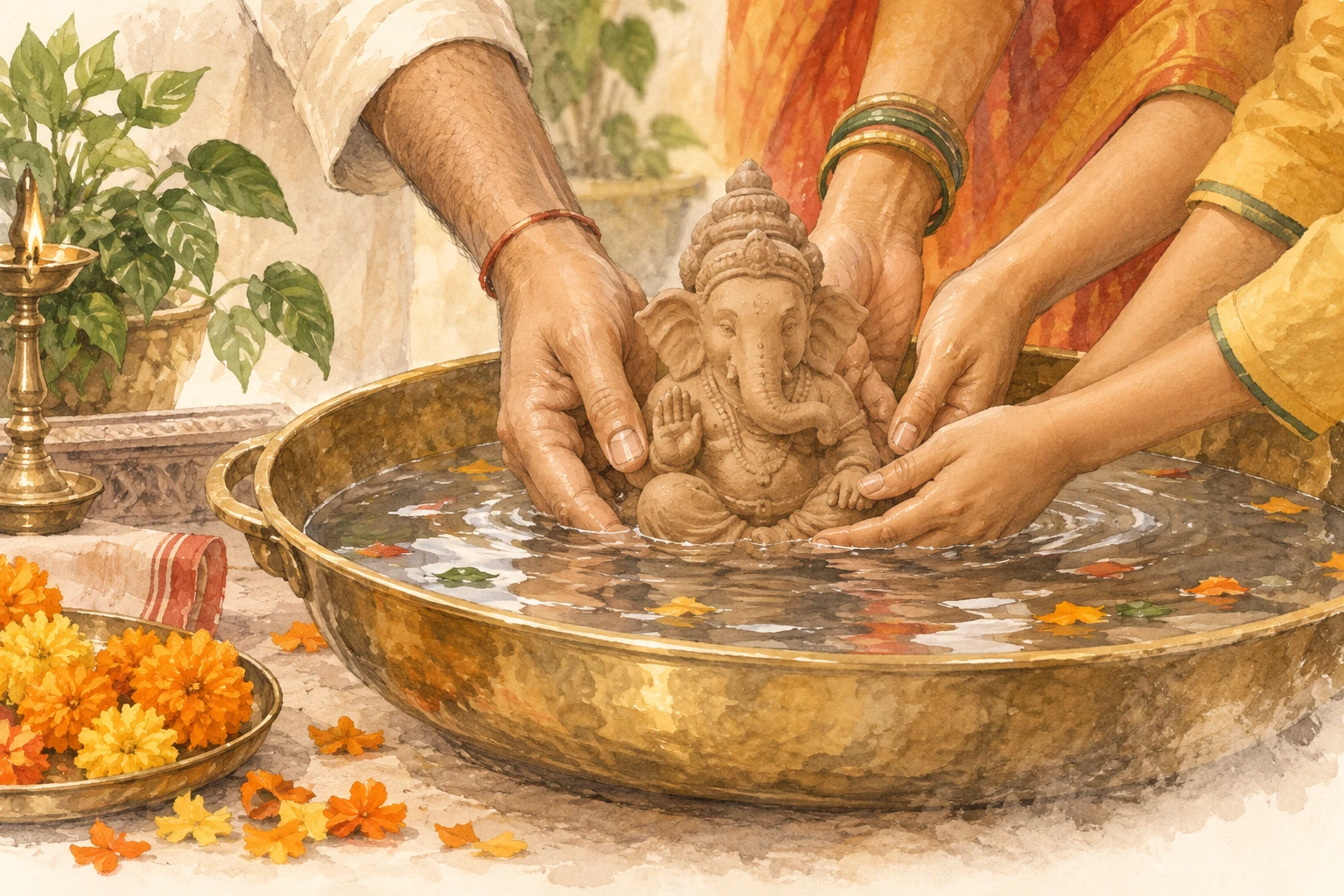
89What is Ganesh visarjan, and what is its spiritual meaning?
Visarjan is the ritual farewell that concludes the temporary festival worship; immersion is its familiar material expression for a suitable festival idol.
In practice. Perform the farewell before moving the image and choose a suitable, permitted immersion arrangement.
Meaning & story. Returning the temporary form to its elements can teach gratitude and letting go. It does not mean devotion to Ganesh Ji ends.
Across traditions. Theological explanations and farewell rites differ between traditions.
90How should the visarjan day be selected, and how are the days of the celebration counted?
Select the departure observance before installation and verify its actual date in the local panchang. The installation date is ordinarily counted as the first day in household day-counting.
In practice. For one-and-a-half-day or other named customs, ask how your family counts the departure. Use the calendar date of Anant Chaturdashi rather than assuming a fixed ten-day interval.
Meaning & story. Clear planning allows a composed farewell.
Across traditions. Tithi lengths and calendar-day counting can differ; use the observance actually chosen.
91What is the sequence of the farewell puja, final offering, aarti and prayer before moving the idol?
A simple farewell includes fresh offerings, prayer, aarti, gratitude and the customary request to conclude the temporary worship. Move the idol only after this farewell.
In practice. Remove loose decorations and jewellery, prepare the carrier or vessel, then lift the idol by its base.
Meaning & story. The farewell honours the period of hospitality.
Reference Practical household guidance
Across traditions. Uttara puja, udvasana and visarjana terminology and gestures vary by manual.
92What should devotees say or pray while bidding farewell to Ganesh Ji?
Offer gratitude and ask for wisdom and wellbeing: “Ganesh Ji, accept our worship, forgive our unintended mistakes and remain in our hearts as we complete this celebration.”
In practice. The family may also chant “Ganapati Bappa Morya”. Speak in a language everyone understands.
Meaning & story. The prayer expresses affection without creating a new promise unintentionally.
Reference Practical household guidance
Across traditions. Phrases asking Ganesh Ji to return next year are customary; a formal vow is a separate matter.
93How should the idol be moved and carried respectfully for visarjan?
Support the base securely, clear the route and use enough adult help for the weight. Transport the image upright.
In practice. Do not carry a lit lamp while handling the idol. At a public facility, follow attendants’ directions and remain behind safety barriers.
Meaning & story. A respectful farewell includes careful handling and calm movement.
Reference Practical household guidance
Across traditions. Public processions may have specific permitted routes and schedules.
94Can a suitable clay idol be immersed at home, and what arrangements are needed?
A small, unfired natural-clay idol can be immersed at home where that suits your tradition and local arrangements.
In practice. Use a stable vessel large enough for the idol, remove detachable décor and lower it gently after the farewell. Allow the clay to soften naturally and plan collection of the residue.
Remove the garland, ornaments and loose decoration. Keep flowers in a separate bowl. The watercolour is a devotional illustration; use the material-care instructions for your actual idol.
Meaning & story. The home setting allows a quiet, personal conclusion.
Across traditions. Fired clay, plaster, metal and unknown coated materials need a different disposal plan.
95What should the family do if the clay idol does not fully dissolve during home immersion?
Allow more time. Clay normally softens and disperses rather than chemically dissolving; its speed depends on thickness, firing and coatings.
In practice. Keep the vessel safely covered. Do not add drain cleaner, acid or other chemicals. If it remains hard, ask the maker about the material or use an authorised collection service.
Meaning & story. A slow physical process is not an omen or a sign that the prayer failed.
Reference Practical household guidance
Across traditions. Even an item sold as “clay” may contain fired material or binders; do not assume all residue is garden-safe.
96What local immersion facilities and current instructions should the family check before going out?
Check your municipality’s current festival notice for designated tanks, collection points, timings, material restrictions and transport arrangements.
In practice. Also check local police traffic instructions and State Pollution Control Board notices. Confirm the facility accepts your idol’s material before travelling.
Meaning & story. Planning reduces uncertainty and helps protect shared spaces.
Reference CPCB · idol-immersion guidance
Across traditions. Rules can change by city and year; this evergreen guide does not claim a nationwide immersion permission.
97How should a permanent household idol be treated at the end of the festival?
Keep a permanent household idol in its shrine and continue its regular worship. A festival ending does not mean the permanent image should be immersed.
In practice. Conclude the special offerings appropriately and return to the usual daily routine.
Meaning & story. Continuing devotion remains after the temporary celebration is complete.
Across traditions. An established consecrated image should be handled according to its existing ritual guidance.
98How should flowers, decorations, immersion water and remaining clay be handled respectfully?
Separate flowers and leaves from cloth, plastic, metal and other decoration. Use local nirmalya collection or appropriate composting for clean plant material.
In practice. Collect clay residue for an available reuse programme or follow municipal disposal directions. Keep sludge out of drains; do not assume painted immersion water is suitable for plants.
Meaning & story. Careful separation supports a respectful, cleaner conclusion.
Reference CPCB · idol-immersion guidance
Across traditions. Reuse, soil application or water disposal depends on known materials and local instructions.
99What should the family do if the idol is accidentally damaged during worship or transport?
First prevent further damage and remove any sharp fragments safely. An accident need not be interpreted as a bad omen.
In practice. Keep the image and pieces respectfully together and ask a trusted priest about repair, replacement or an appropriate conclusion. Tell them whether it is a temporary or permanent idol.
Meaning & story. A calm response allows respectful care.
Reference Practical household guidance
Across traditions. Advice depends on the material, damage and the image’s ritual status; one remedy does not fit every case.
100Does celebrating once create an obligation to bring Ganesh Ji home every year?
There is no universal rule that one celebration automatically commits every household to bringing a new idol home every year.
In practice. Continue when you can do so with care. If you explicitly made a vow, discuss its terms and any changed circumstances with your priest.
Meaning & story. A chosen devotion and a specific promise are different matters.
Reference Practical household guidance
Across traditions. A family custom may carry personal importance without becoming a rule for everyone.
101Is there a tradition of committing to bring Ganesh Ji home for a specific number of years (1, 3, 5, 7, or 11), and what is its significance?
Some families make a personal sankalpa to celebrate for a chosen number of years. Lists such as 1, 3, 5, 7 or 11 reflect particular customs, not one universal mandatory series.
In practice. Make only a commitment you understand and can realistically maintain. Seek guidance about concluding or adapting an existing vow.
Meaning & story. A vow can express continuity and gratitude when entered freely.
Reference Practical household guidance
Across traditions. No single scriptural rule establishing this whole number-series is claimed here.
102What lessons from the celebration can the family continue practising throughout the year?
Carry forward clear thinking, patient listening, generosity and care for the natural world. These values can give the festival a place in everyday life.
In practice. Choose one small continuing habit: pause before a decision, share a meal, help someone or maintain a moment of daily prayer.
Meaning & story. The temporary celebration can leave a lasting practice.
Reference Practical household guidance
Across traditions. Choose a habit that is meaningful within your own family’s life.
READ FURTHER
Sources & reading notes
Sacred narratives, historical accounts and practical household suggestions are identified separately. Layouts, quantities, budget allocations and example prayers are original guidance. They are not presented as universal religious requirements. For a specific vrata or family commitment, follow the tradition you have chosen.
Illustrations are devotional watercolours. Follow the written handling and immersion guidance for your actual materials. This guide is currently in English.
- Maharashtra Tourism · Ganesh Chaturthi
Festival background and the expansion of public Ganeshotsav.
- Shiva Purana · birth narrative
Rudra-samhita, Kumara-khanda, chapter 13; a sacred narrative.
- Shiva Purana · restoration of Ganesh Ji
Kumara-khanda, chapter 17.
- Shiva Purana · first-worship honour
Kumara-khanda, chapter 18.
- Goa Tourism · Chovoth
Goan home celebrations and regional customs. Other regional notes are a general editorial overview.
- Himalayan Academy · home worship
A named Shaivite tradition’s home-puja teaching. Its wider rules are not presented as universal.
- CPCB · idol-immersion guidance
2020 environmental guidance; current local notices must also be checked.
- Himalayan Academy · Ganesh worship and meaning
Devotional teaching, including the association with red flowers.
- Ganapati Atharvashirsha · offerings
Traditional Sanskrit text; mentions durva and modak. Interpretive notes are original editorial explanations.
- Traditional offering vocabulary · Sanskrit reference
A Sanskrit Ganesh puja text for offering terminology. Its vrata-specific instructions are not substituted for Ganesh Chaturthi rules; the practical sequence here is an original household synthesis.
Reference access: 13 September 2026. Local timings and immersion notices should be checked for your city and year.