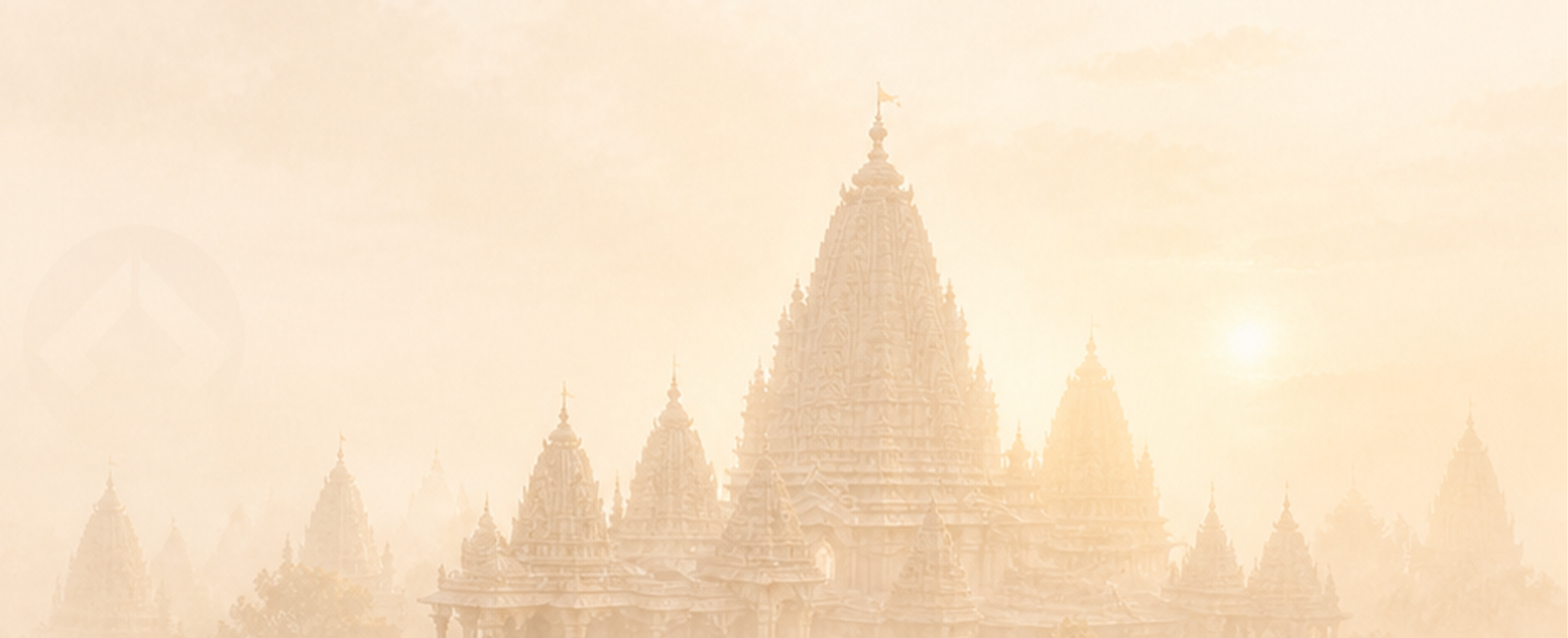
Ratna Sinhasan
The Jagannath group is worshipped together in the principal sanctum.
 Divine Mandir
Dharakot, Ganjam, Odisha, India
A royal Kalinga-style Jagannath temple associated with the Dharakot dynasty, the Rani’s Chhera Panhara tradition and the twice-yearly Ekadasi Cart Festival.
Official Notice / Visitor Information: The source describes midday dhupa between noon and 4:00 PM and varying closing reports. Confirm the current darshan windows locally.
Source: DM-JN-008-A_OD.docx. Confirm time-sensitive details before travelling.
Dharakot temple guide
Jagannath Mandir at Dharakot is a royal temple shaped by several phases of patronage from the Dharakot ruling family.
Its distinctive living traditions include the Queen’s ceremonial chariot sweeping and an Ekadasi Cart Festival described as drawing tens of thousands of pilgrims.
Source-defined sanctum identity
Jagannath is worshipped as Daru Brahma with Balabhadra, Subhadra and Sudarshana on the Ratna Sinhasan.
The Jagannath group is worshipped together in the principal sanctum.
The source describes worship traditions modelled on Puri.
The Dharakot family has sustained the temple across generations.
Identity and pilgrimage context
The temple expresses the Dharakot dynasty’s service to Jagannath.
The ceremonial sweeping role belongs to the Rani rather than the Raja.
A twice-yearly cart festival gives Dharakot a distinctive public ritual identity.
Sacred narrative, carefully framed
The temple’s royal chronology begins with a foundation laid by Raja Jai Singh and continues through later building and enclosure phases.
The Sathi Math preserves an eternal-flame tradition connected in local memory with Rani Chandama Devi; this is presented as temple tradition.
Source-recorded temple chronology
The foundation dates to 1732; the main structure was built around 1850–1860.
The boundary wall is recorded as a 1914 addition under Raja Madan Mohan Singh Deo.
Form, material and sacred setting
Rekha-Deul forms and a curving Sikhara recall the Puri tradition.
A Mukhya Mandapa and Natya Mandapa organise gathering and performance space.
Stonework and murals use traditional narrative motifs.
The source describes a plan aligned to cardinal principles.
The historic Dharakot Maharaja Palace stands adjacent.
A monastery and flame shrine form part of the extended sacred complex.
What makes this temple distinct
The Queen performs the ceremonial chariot sweeping.
The cart celebration is held twice yearly and draws major crowds.
A continuously tended sacred flame is central to the associated tradition.
Several rulers contributed to the temple and boundary.
The adjacent royal building reinforces the historic patronage setting.
Architecture and worship maintain a clear regional link to Puri.
Choose the planning path that fits your visit.
Visit fit
A royal Kalinga-style Jagannath temple associated with the Dharakot dynasty, the Rani’s Chhera Panhara tradition and the twice-yearly Ekadasi Cart Festival.
Typical duration: Allow 1–2 hours, more for the palace and Sathi Math context.
Plan the sequenceSeason and crowds
Generally pleasant weather for the Ganjam region.
Compare visit periodsMobility and family care
The Sathi Math and the royal palace are historically connected spaces. Follow current access directions and treat the eternal-flame tradition with care.
Review access guidanceConfirm before visiting
The source describes midday dhupa between noon and 4:00 PM and varying closing reports. Confirm the current darshan windows locally.
Use reference notesA practical eight-step flow. Current on-site directions always take priority.
Begin with the current entrance and access directions.
Continue quietly and follow current temple directions.
Continue quietly and follow current temple directions.
Continue quietly and follow current temple directions.
Continue quietly and follow current temple directions.
Continue quietly and follow current temple directions.
Continue quietly and follow current temple directions.
Leave circulation areas clear and continue to optional nearby places only if time allows.
Shri Jagannath Mandir, Dharakot, Dharakote Block, Ganjam District, Odisha 761107, India.
Source-recorded visitor periods with local confirmation required.
The source describes midday dhupa between noon and 4:00 PM and varying closing reports. Confirm the current darshan windows locally.
Daily ritual names and broad periods are source-recorded; ask at the temple for the current sequence and public access.
Source-described annual observances
Held twice yearly and identified as Dharakot’s defining celebration.
The annual Jagannath chariot festival follows the broader Puri calendar.
The ceremonial bathing is observed before the chariot season.
Summer sandalwood worship forms part of the ritual calendar.
Respectful personal participation
Approach the principal sanctum through the current worship route.
Circumambulate only where the temple’s present instructions permit.
Observe the sacred-flame setting quietly and without intrusive photography.
No unverified mantra from the source DOCX is reproduced on this page.
Temple-centred practice
Royal-temple darshan: Approach the principal sanctum through the current worship route.
Parikrama: Circumambulate only where the temple’s present instructions permit.
Sathi Math: Observe the sacred-flame setting quietly and without intrusive photography.
Continue with five focused topics in the Lord Jagannath hub.
Confirm current arrangements
Morning, midday and evening food offerings are described in the source.
Arrange name-recitation or other services only through current temple personnel.
Confirm accepted items before offering.
Season and crowd planning
Generally pleasant weather for the Ganjam region.
Choose the January or December celebration for Dharakot’s distinctive cart tradition.
A practical window for darshan and the surrounding heritage context.
Source-listed extensions for practical planning
Adjacent. The historic royal residence connected with the temple.
Open mapWithin the extended complex. The monastery associated with the eternal flame.
Open mapApproximately 15 km. A major regional river landscape.
Open mapApproximately 45 km. A coastal extension near Brahmapur.
Open mapApproximately 50 km. A major Shakti pilgrimage destination.
Open mapApproximately 180 km. The principal temple mirrored in Dharakot’s tradition.
Open mapA compact suggested route around this visit.
This is a suggested visitor route, not an official compulsory pilgrimage order. Reorder stops according to current access, weather and personal mobility.
Before you enter
Source-bound answers for visit planning.
Source material used for careful framing.
DM-JN-008-A_OD.docx is the primary source for identity, coordinates, elevation, timings, history, traditions, travel and nearby-place material.
The document’s recorded website list provides its research context; this page does not add outside factual claims.
Opening hours, access, transport and festival arrangements can change and should be reconfirmed.
Source path: data/Jagannath-mandir/Batch-01-Temple-Data/DM-JN-008-A_OD.docx