
CHAPTER 1
The story and scriptural background
The Navratri story most widely known is Maa Durga's victory over Mahishasura, remembered alongside older and regionally distinct traditions.
In the Devi Mahatmya, Mahishasura defeats the devas and overturns the order of their world. Their radiance unites as the Goddess. Armed with their gifts and mounted on a lion, she meets the demon as he changes from buffalo to lion, warrior and elephant. She finally overcomes him. Devotees honour her as Mahishasuramardini.
The story is often read devotionally as a reminder to confront arrogance and injustice with disciplined courage. That reflection is an interpretation; the text does not present one battle scene as a literal event for each festival night.
Reverence for the divine feminine reaches into Vedic literature. The Devi Sukta of the Rigveda speaks in the voice of a divine power present everywhere, while the Ratri Sukta addresses the goddess of Night. These hymns form part of the wider background, but they are not a modern calendar of nine days. The Devi Mahatmya, Devi Bhagavata Purana and associated Devi Kavacha provide more direct foundations for the stories, worship and nine names discussed here.
01What does Navratri mean and what is the festival's central focus?
Navratri means “nine nights”. Across many traditions, the festival centres devotion on Shakti, the Divine Mother's power that sustains life, protects her children and confronts injustice.
In practice. Families may pray at home, visit a temple, fast, attend garba, arrange a Golu display, honour books or share food and service.
Across traditions. One household's inherited method should not be treated as a rule for every region.
02Does scripture say that one scene of the Mahishasura battle happened on each of the nine festival days?
No assignment of one scene to each day is claimed here. The battle narrative and the living observance over nine nights are closely connected devotionally, but their details and timing are not identical in every telling.
Meaning & story. The eight illustrated scenes are a concise retelling for reflection, not a new ritual calendar.
03How is Navratri connected with Lord Rama?
The Devi Bhagavata Purana describes Narada advising Rama to worship the Goddess. Bengali tradition remembers Rama's autumn invocation as Akal Bodhan.
Across traditions. These belong to particular Puranic and regional traditions and should not be attributed to every version of the Ramayana.
CHAPTER 2
When Navratri is celebrated
Dates follow lunar tithis, not a permanently fixed Gregorian range.
| Observance | Hindu month | Usual Gregorian season | Main association |
|---|---|---|---|
| Chaitra Navratri | Chaitra | March or April | Spring worship of the Goddess; Rama Navami falls on the ninth tithi. |
| Sharad Navratri | Ashwin or Ashwayuja | September or October | Autumn worship, Durga Puja and the approach of Vijayadashami. |
| Magha Gupt Navratri | Magha | January or February | Observed in some Shakta traditions, often through more private practice. |
| Ashadha Gupt Navratri | Ashadha | June or July | A further private observance followed by some Shakta practitioners. |
A tithi may begin or end during a civil day. One tithi may occur at two consecutive sunrises. That is why a sequence of nine tithis does not always fit neatly into nine Gregorian dates. Follow the panchang used by your household or temple for Ghatasthapana, Sandhi Puja, homa, parana and formal fast conclusions.
A calendar note for Sharad Navratri 2026
The guide's New Delhi example separates the popular annual dress colour sequence from the ritual calendar. It is a planning note, not a substitute for local temple announcements.
| Date in October 2026 | Worship or calendar note | Popular dress colour |
|---|---|---|
| 11 October | Pratipada and Shailputri; Ghatasthapana | Orange |
| 12 October | Dwitiya and Brahmacharini | White |
| 13 October | Tritiya and Chandraghanta | Red |
| 14 October | Chaturthi and Kushmanda | Royal blue |
| 15 October | Panchami and Skandamata | Yellow |
| 16 October | Shashthi and Katyayani | Green |
| 17 October | Saptami; Kalaratri Puja is listed | Grey |
| 18 October | Saptami continues in the sunrise calendar | Purple |
| 19 October | Ashtami and Mahagauri; Mahanavami Puja and Sandhi Puja are also listed | Peacock green |
| 20 October | Navami observance, Siddhidatri worship, homa and parana; Vijayadashami is also listed | No additional colour in the cited list of nine colours |
04Why does the 2026 example span ten civil dates when Navratri means nine nights?
The annual colour list has nine entries, while the tithi sequence based on sunrise in this example extends across ten dates because Saptami is present at two consecutive sunrises.
In practice. Use the ritual calendar for worship and the colour list only as a festive clothing custom.
05Can this New Delhi calendar be reused for every city or temple?
No. Location, sunrise, the selected almanac and institutional practice can change the displayed schedule.
In practice. Select your city and year in a reliable panchang and confirm a formal temple rite with that institution.
CHAPTER 3
The nine forms of Maa Durga
This Navadurga order is widely followed in northern Indian worship. Other regions may organise the nine days differently.
The colours, flowers and offerings are examples of common devotional associations. Family custom, local availability and temple practice differ; omitting an item does not make sincere worship incomplete.
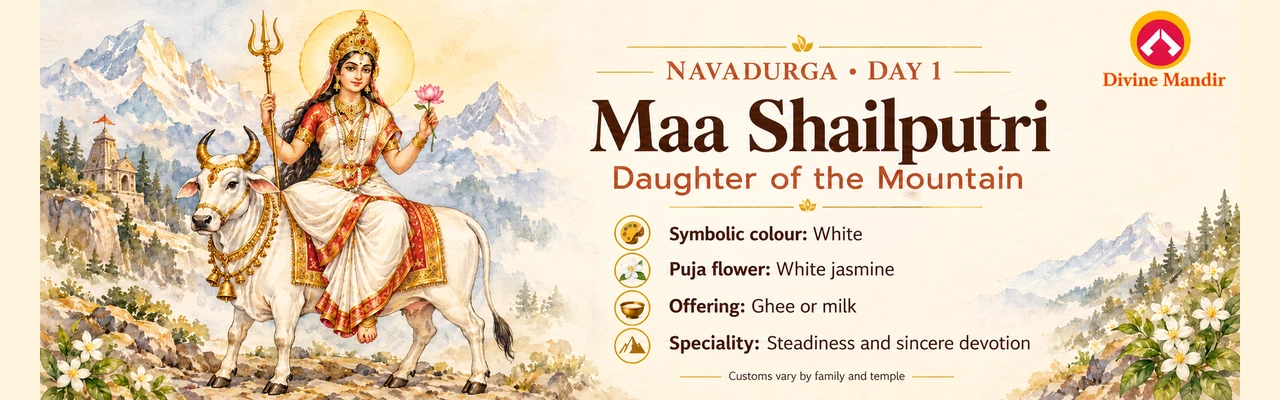
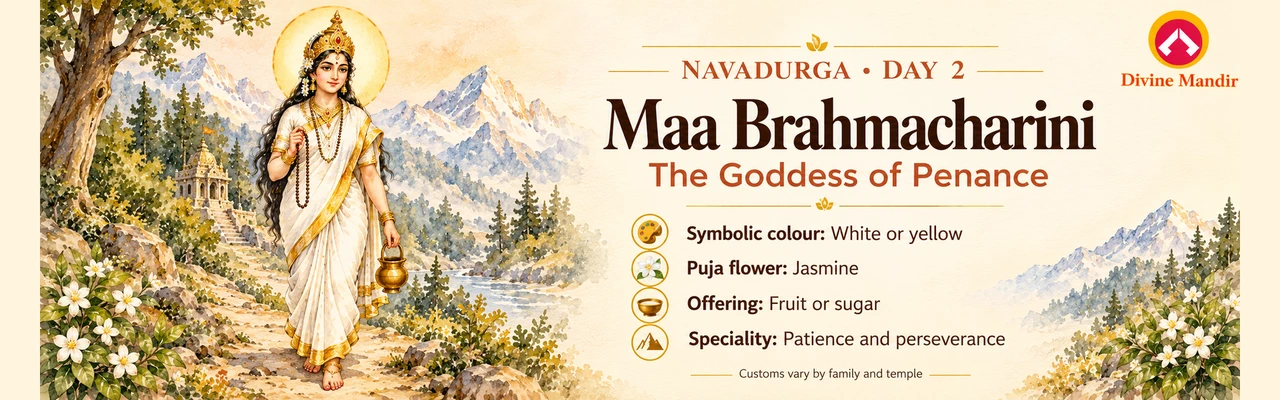
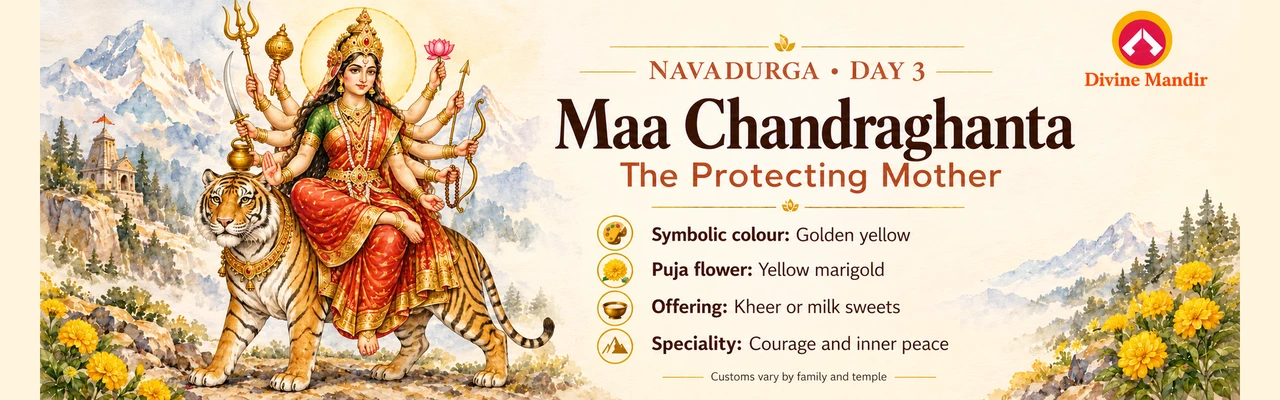
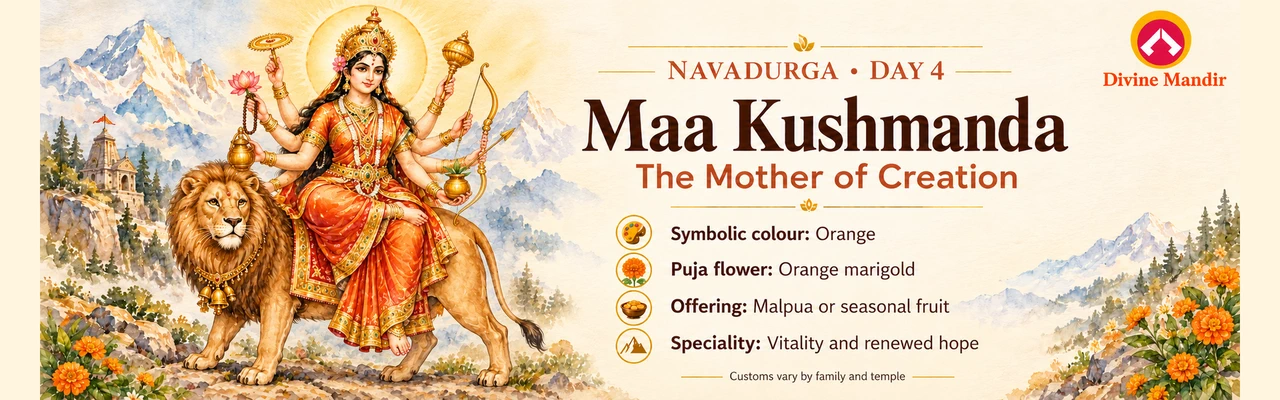


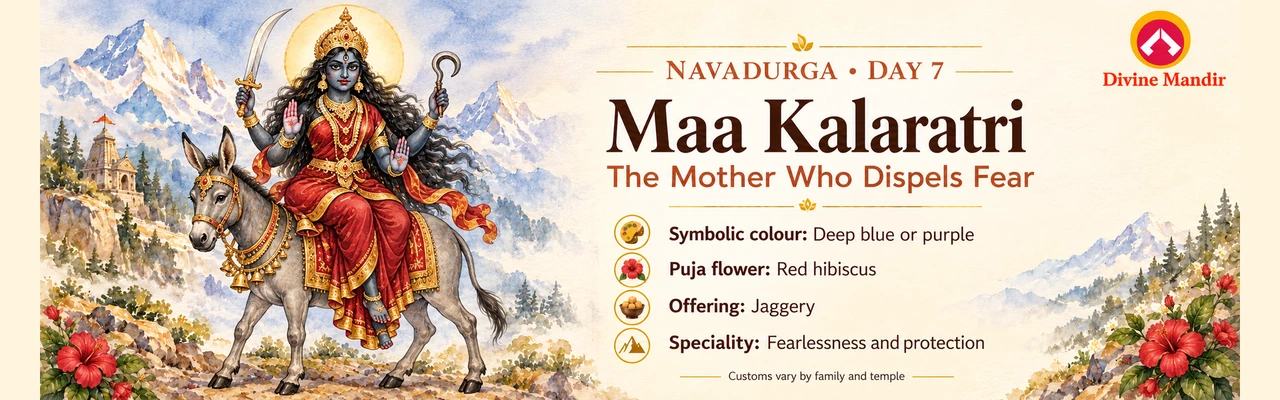
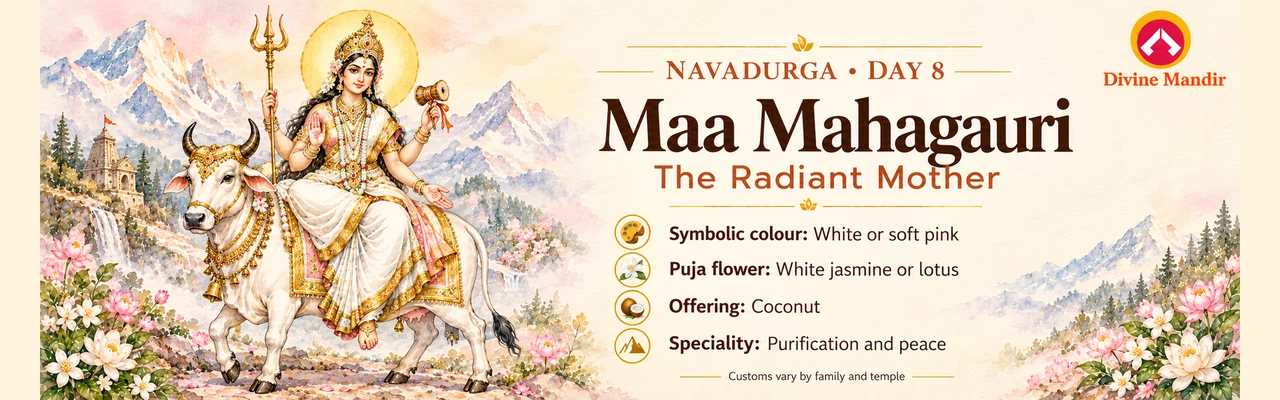
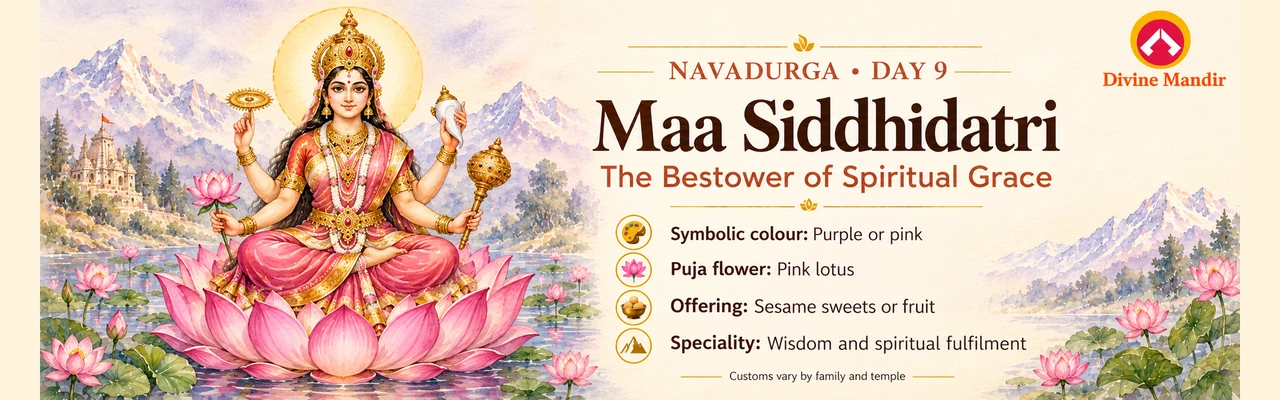
06Must every region worship the nine forms in this exact order?
No. This is a widely followed Navadurga order, especially familiar in northern Indian practice.
Across traditions. Some southern traditions organise the days around Durga, Lakshmi and Saraswati, while temples may follow their presiding deity and established calendar.
07What should a family do if a listed flower or food is unavailable?
Use a clean, suitable local flower or fresh seasonal fruit according to your practice. The table and banners give examples, not exclusive requirements.
In practice. Offer only an amount that can be shared or received respectfully as prasad.
CHAPTER 4
Maa Durga and Mahishasura
An illustrated retelling in eight scenes based on the Devi Mahatmya, especially chapters 2 and 3.
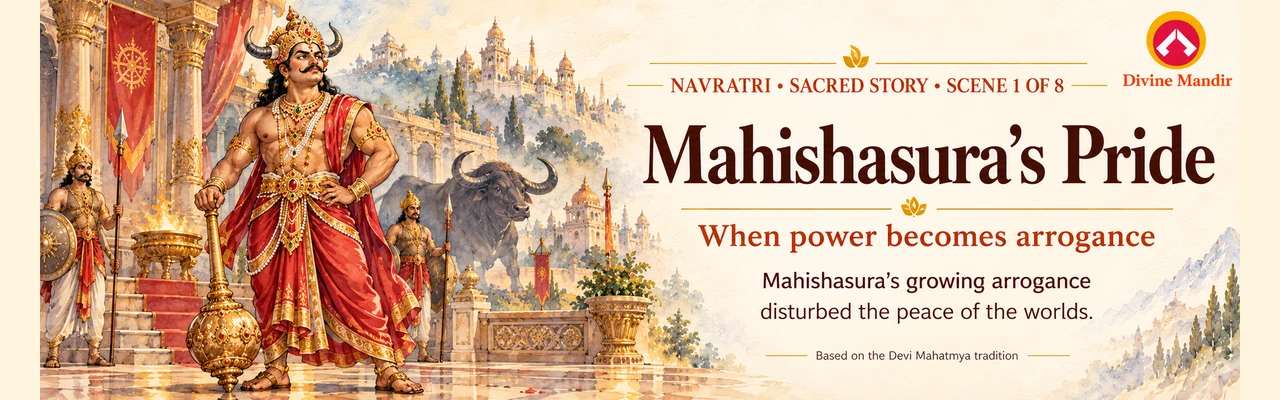
When power becomes arrogance
Mahishasura's strength grows into arrogance, disturbing the peace of the worlds. The defeated devas seek protection and a way to restore order.
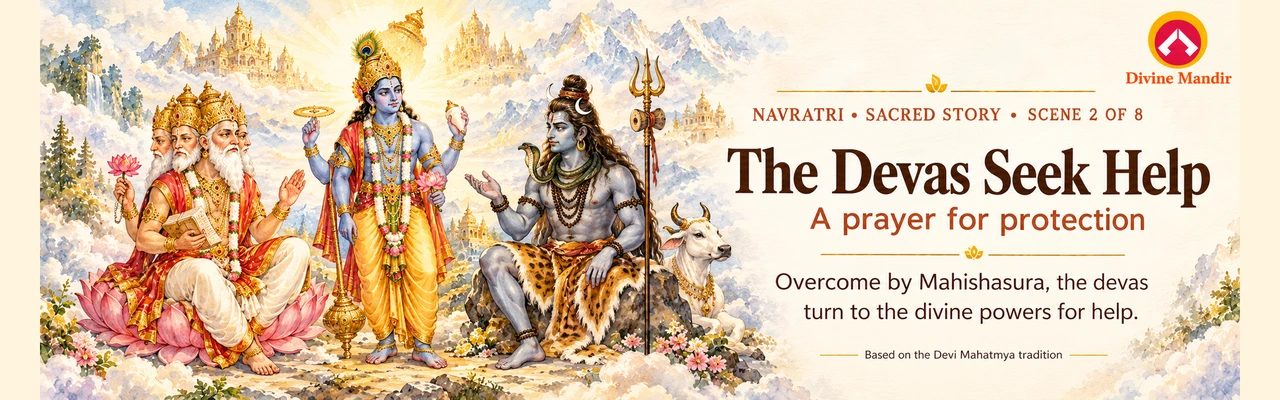
A prayer for protection
The devas turn to Brahma, Vishnu and Shiva and speak of the suffering caused by Mahishasura. The divine powers answer together.
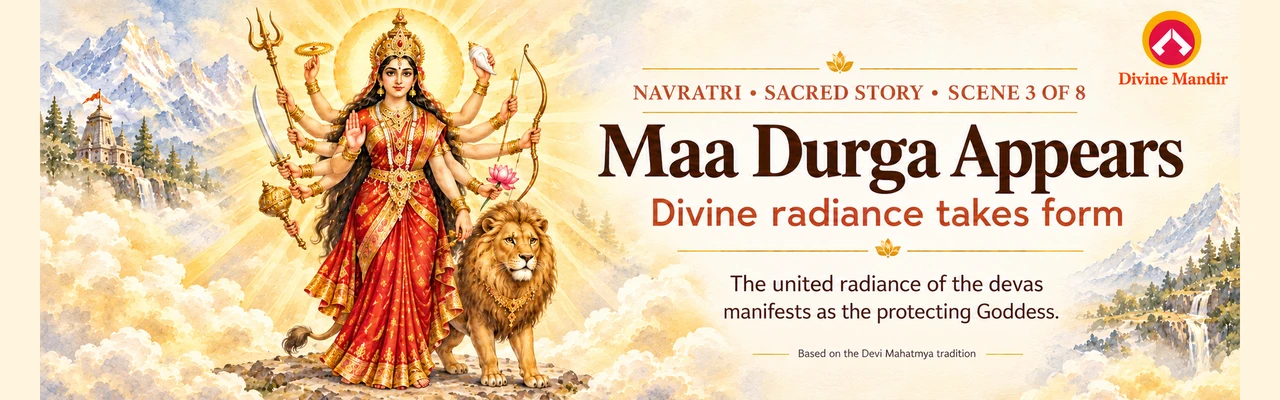
Divine radiance takes form
From the united radiance of the divine powers, a resplendent Goddess appears. Her presence gives strength and hope to the devas.

Strength gathered for dharma
The devas offer their weapons and powers. Shiva gives a trident and Vishnu gives a discus. The mountain king gives her a lion.
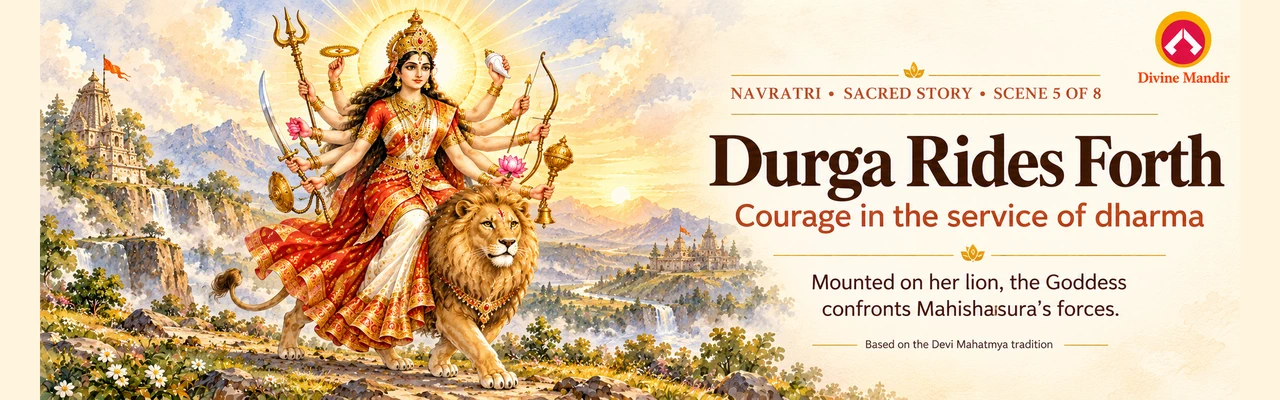
Courage in the service of dharma
Mounted on her lion, the Goddess confronts Mahishasura's forces. Her courage serves the order that sustains and protects life.
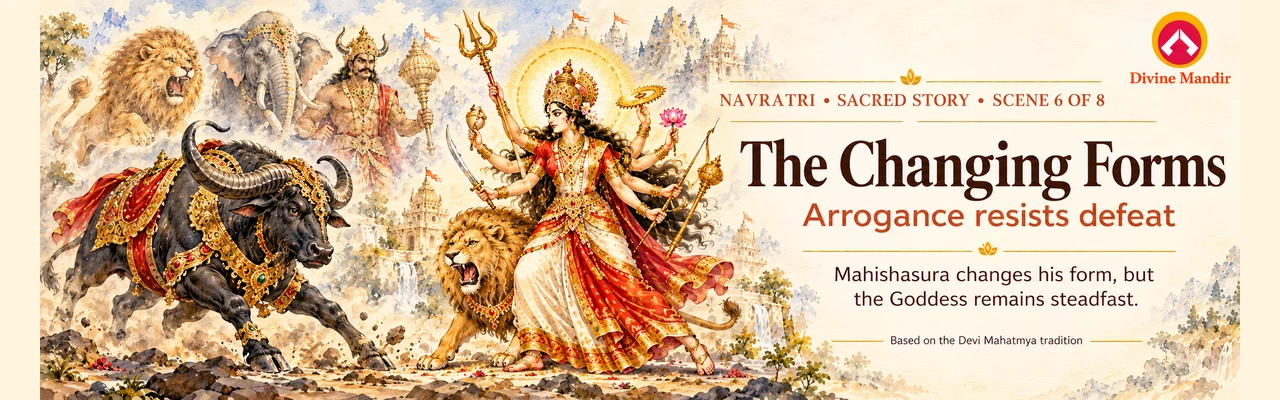
Arrogance resists defeat
Mahishasura resists through changing forms: buffalo, lion, warrior and elephant. The Goddess remains steadfast. Devotionally, the passage can also suggest the many shapes taken by anger and arrogance.

Dharma is restored
The Goddess defeats Mahishasura and restores the order he overturned. The devas praise Mahishasuramardini as a source of protection and hope.

Remembering the Divine Mother
Devotees honour Maa Durga through prayer, lamps, offerings and acts of kindness, following the customs of their family and region.
CHAPTER 5
Flowers, bhog and colours
Offerings express devotion; they are not a competition or a single universal checklist.
Fresh flowers and food offerings differ across temples and families. Lotus, marigold, rose, jasmine and locally used temple flowers are all encountered. Food offered as naivedya is received afterwards as prasad. Use clean ingredients and prepare only what can be shared without waste.
Do not confuse customary bhog with food permitted by an individual's fast. Ordinary malpua may contain wheat. Ordinary rice kheer may not suit a vrata without grains. Flowers belong on the altar; unfamiliar ornamental flowers should not be added to food.
Three different things are often called a Navratri day's colour: the Goddess's iconographic appearance, a temple's decoration and the popular colour worn by devotees. Annual dress colour lists can change by weekday and region. Devotion does not depend on owning a particular colour of clothing.
08Are the banner colours a dated dress colour calendar?
No. They are symbolic design associations for each illustrated form and are not the changing annual Navratri dress colour sequence.
09Must prasad match a single published list?
No. Follow the custom of your home or temple and use suitable local ingredients. A clean seasonal fruit is practical when a particular preparation is unavailable.
Across traditions. A temple bhog and an individual's fasting food can come from different rules.
CHAPTER 6
What happens in temples
A temple follows its own deity, lineage and established service schedule.
The presiding deity may be Durga, an Amman form, Sharadamba, Chamundeshwari or another form of the Mother. Temples may change the deity's decoration daily; others keep one form throughout the festival.
Common services include ceremonial bathing where appropriate, new garments and ornaments, flower decoration, archana with the deity's names, food offerings and morning or evening aarti. Some institutions arrange Durga Saptashati recitation, Lalita Sahasranama archana, Chandi homa, processions, Suvasini Puja or Kumari Puja.
Sandhi Puja is associated with the junction of Ashtami and Navami in Bengali Durga Puja. Its timing follows the tithi transition and may occur at any clock hour. Visitors should follow the temple's published notice, dress code, queue arrangements and photography rules.
10Does every Durga temple conduct the same Navratri rites?
No. Ritual vocabulary, recitations, offerings, timing and public access vary with the institution's established tradition.
In practice. Check the temple's own schedule and follow directions from its authorised staff.
11What should a visitor know about bali references?
Some Shakta traditions retain bali customs, while many institutions use symbolic offerings. Do not assume that every temple follows the same practice.
Across traditions. Follow the institution's current guidance without generalising from one temple to another.
CHAPTER 7
How to worship at home
A modest, attentive household puja is a sound beginning.
- Prepare the space. Clean a stable altar and arrange a suitable image of Maa Durga, water, a lamp and wick, flowers, kumkum, sandal paste if used, fruit and the day's offering.
- Make a clear sankalpa. After bathing and wearing clean clothes, remember Ganesha according to your practice and state an intention you can realistically keep.
- Perform Kalash Sthapana if it is your custom. Methods and materials differ, so retain the arrangement taught in your family and confirm the local Ghatasthapana time.
- Keep a simple daily rhythm. Clean the immediate altar area, offer fresh water and flowers, remember the day's form, offer incense or fragrance if used, light the lamp safely and present naivedya.
- Read or listen with understanding. A family may read the Devi Mahatmya, listen to a knowledgeable reader, recite a familiar stotra or sing a devotional song.
- Prepare the conclusion. Arrange Kanya Puja or havan only if part of your practice; offer final prayer, complete promised service or feeding and follow the proper parana time.
An akhand jyoti should be undertaken only when someone can attend it safely. Keep any flame on a stable, nonflammable surface away from clothing, curtains, children and pets. A lamp lit only during supervised prayer is a practical choice.
12Does a beginner need a complete priestly ritual manual?
No. Begin with a clean place, sincere prayer, a supervised lamp, water, flowers and food offered with attention.
In practice. Seek a knowledgeable priest or family elder when undertaking a formal vrata, specialised mantra, homa or practice specific to a lineage.
13What if an uninterrupted lamp goes out?
Attend to it calmly and safely. A flame going out is not a reason to frighten the household.
Across traditions. Ask your own teacher about any customary prayer connected with a formal vow.
CHAPTER 8
Fasting and the conclusion of the vow
A vrata is a religious commitment, not a test of endurance imposed on everyone.
Households follow several forms of fasting. Phalahar generally allows fruit and foods accepted by that tradition. Ekabhukta refers to one meal, while nakta refers to taking the permitted meal at night. Some devotees keep ordinary vegetarian meals while giving up selected foods; others observe only chosen tithis.
In many northern and western households, accepted foods include fruit, milk or curd, nuts, sabudana, water chestnut flour, buckwheat, amaranth and sama millet. Many avoid wheat, ordinary rice, pulses, onion, garlic, eggs, meat and alcohol. Rules vary even between neighbouring families, so ask what your own vow permits.
Food restriction should be adapted to health. Anyone pregnant, unwell, managing diabetes or affected by food restriction should seek individual medical advice. Do not change prescribed medicines independently. Children should not be pressured into a demanding fast.
Some families perform Kanya Puja on Ashtami and conclude after that worship; others continue through Navami, honour Siddhidatri and perform a concluding puja or havan. A formal fast for nine tithis may conclude on Dashami at the appropriate time. The sankalpa, inherited practice and panchang determine the conclusion.
14Does Navratri fasting always mean giving up water?
No. A dry fast is a separate, demanding observance and is not the expected universal method.
Health note. If fasting causes illness, stop the restriction and seek appropriate care. Prayer, service and offerings can continue without food restriction.
15Why do some families conclude on Ashtami and others on Navami?
Their vows and inherited customs are different. Kanya Puja, the last fasting tithi and parana are related but separate actions.
In practice. Do not use the timing of Kanya Puja alone to judge another person's fast.
CHAPTER 9
The meaning and method of Kanya Puja
Kanya Puja, also called Kanjak in many northern homes, honours the Divine Mother through young girls.
Nine girls are often invited in remembrance of Navadurga. Some families also invite a boy, called a langur or languriya in local usage. Numbers and methods differ. The custom can be observed respectfully with the children who are available.
Welcome the children with their families' agreement, provide clean seating, ask before washing feet or applying tilak and ensure every action is comfortable for them. Serve food they can safely eat, ask about allergies and offer a modest gift or dakshina according to your means.
Halwa, puri and black chickpeas are a familiar northern meal, but they are not the only form of Kumari worship. Some institutions worship one Kumari through a formal ritual, while households may feed several children more simply. The respect expressed during puja should continue in daily life.
16Must exactly nine girls attend for the worship to be sincere?
No universal rule is asserted here. Follow your household's method and treat the children who can attend with safety, dignity and consent.
In practice. Never pressure a child or family to participate and ask about food allergies before serving.
CHAPTER 10
Navratri across India
The same devotional season holds distinct household, temple and public traditions.
Northern India
Household vrata, Ghatasthapana, barley sowing, Devi temples, bhajans, jagran and Kanya Puja are familiar. Ramlila and Dussehra share the season. Pilgrimages such as Vaishno Devi become especially prominent.
Eastern India
Durga Puja welcomes the Goddess with public images and pandals. Shashthi through Dashami centre Bodhan, Nabapatrika, anjali, Sandhi Puja, homa, shared bhog and farewell rites. Odisha, Assam, Bihar and Jharkhand retain their own local forms.
Western India
Garba honours Amba or Ambika through circular dance around a sacred centre; dandiya raas has its own performance traditions. Maharashtra also highlights Ghatasthapana, household fasting, Devi shrines and annual dress colours.
Southern India
Tamil Nadu's Golu or Kolu brings stepped doll displays and family visits. Many households group the days around Durga, Lakshmi and Saraswati. Karnataka has Mysuru Dasara, while Kerala has book worship and Vidyarambham. Andhra Pradesh and Telangana have distinct temple and Bathukamma traditions.
Central and Himalayan regions add further traditions. Bastar Dussehra centres Maa Danteshwari through an extended local ritual season, while Kullu Dussehra gathers regional deities around Vijayadashami. A summary of four regions cannot describe every Indian community.
17Are garba and dandiya two names for the same dance?
No. They are often enjoyed during the same festival gatherings, but garba and dandiya raas have distinct forms, histories and performance traditions.
18Do northern fasting rules that exclude grains describe all of Durga Puja?
No. Bengali Durga Puja bhog, southern sundal and northern vrata meals come from different regional practices.
Across traditions. Shared devotion does not require identical food customs.
CHAPTER 11
Navami and Vijayadashami
The concluding observances carry different emphases while sharing a movement from worship into daily conduct.
Navami completes the sequence of nine tithis and is a major day for Goddess worship, offerings and concluding fire rites. Vijayadashami is the tenth tithi and celebrates victory. Depending on the region, the emphasis may fall on Durga's triumph, Rama's victory, a procession, the worship of tools or the beginning of learning.
Rituals attached to different portions of a tithi can sometimes occur on the same civil date. Check the local calendar rather than assuming the transition occurs at midnight.
When the temporary altar is put away, its useful meaning can remain: make time for prayer, share food without waste, treat children with respect, use tools honestly and carry a vow into the conduct that follows it.
19Are Navami and Vijayadashami always on separate civil dates?
Not necessarily. Tithis begin and end independently of civil midnight. Observances attached to their different portions can share a Gregorian date.
In practice. Use the local panchang and the programme of the temple or celebration you will attend.
READ FURTHER
Sources & reading notes
Sacred texts, institutional descriptions, public calendars and health guidance are identified separately. The concise summaries and practical household suggestions are editorial explanations, not universal ritual requirements. Dates and colours tied to a particular year should be checked again for the relevant city and year.
- Incredible India · Navratri
Festival overview and regional expressions.
- Devi Mahatmya · Chapter 2
The Goddess's manifestation and battle setting.
- Devi Mahatmya · Chapter 3
Mahishasura's changing forms and defeat.
- Devi Bhagavata Purana · Book 3, Chapter 30
Narada's guidance to Rama.
- Vedic Heritage Portal · Rigveda 10.125
Devi Sukta.
- Vedic Heritage Portal · Rigveda 10.127
Ratri Sukta.
- Devi Mahatmya · Chapter 12
Annual autumn worship and listening to the Goddess's deeds.
- Devi Bhagavata Purana · Book 3, Chapter 26
Navratri worship and observance.
- Devi Bhagavata Purana · Book 3, Chapter 27
Ashtami, worship and shorter observances.
- Sanskrit Documents · Devi Kavacha
The traditional Navadurga name sequence.
- Drik Panchang · About Navratri
Festival and calendar background.
- Drik Panchang · Sharad Navratri 2026, New Delhi
Cited example calendar; specific to one location.
- Drik Panchang · Shailputri
- Drik Panchang · Brahmacharini
- Drik Panchang · Chandraghanta
- Drik Panchang · Kushmanda
- Drik Panchang · Skandamata
- Drik Panchang · Katyayani
- Drik Panchang · Kalaratri
- Drik Panchang · Mahagauri
- Drik Panchang · Siddhidatri
- Drik Panchang · Navratri prasad
- Drik Panchang · Navratri colours 2026
- Drik Panchang · Shodashopachara Durga Puja
- Divine Life Society · Durga Puja or Navaratri
- Sringeri Sharada Peetham · Sharannavaratri
- Belur Math · Durga Puja
- Drik Panchang · Ghatasthapana Puja Vidhi
- Drik Panchang · Navratri fasting and ritual FAQ
- Dassana's Veg Recipes · Navratri fasting foods
- Diabetes UK · Religious fasting and diabetes
- Drik Panchang · Navratri parana
- Incredible India · Dussehra
- Shri Mata Vaishno Devi Shrine Board · Attka Aarti
- Incredible India · Durga Puja
- Incredible India · Durga Puja in Odisha
- UNESCO · Garba of Gujarat
- Gujarat Tourism · Navratri Festival
- Maharashtra Tourism · Ghatasthapana
- Ministry of Tourism Utsav · Navarathiri, Tamil Nadu
- Karnataka Tourism · Mysuru Dasara
- Kerala Tourism · Navarathri
- Press Information Bureau · Bathukamma
- Incredible India · Bastar Dussehra
- Maharashtra Tourism · Dussehra
- NTR District · Dasara and Kanaka Durga alankaras
Guide source set supplied for the local Navratri page. Local timings, health advice and temple programmes should be checked with the relevant current authority.